














By Morning Star Editor
Nigeria’s political evolution has been shaped not only by soldiers, lawyers, and career politicians but also by journalists. Trained to interrogate power, journalists have, at critical moments, sought to wield it themselves. From the nationalist era to the present democratic dispensation, the movement from newsroom to public office has been a recurring feature of the country’s political history, reflecting journalism’s deep entanglement with governance, advocacy, and nation-building.

Historically, Nigerian journalism has rarely been neutral. Newspapers served not merely as chroniclers of events but as instruments for shaping public consciousness, contesting authority, and articulating visions of self-rule. During the colonial era, the press became a rallying point for nationalist agitation, challenging imperial authority and amplifying demands for political and social reforms. After independence, it evolved into a forum for democratic debate, criticism, and dissent, remaining a critical check on power in periods of civilian governance and authoritarian rule alike. Against this backdrop, it is unsurprising that many journalists eventually crossed into politics, convinced that the authority to inform could transform into the capacity to reform.
This tradition produced some of Nigeria’s most consequential political figures. Chief Anthony Enahoro, a journalist and parliamentarian, embodied the seamless transition from media advocacy to legislative action. His historic motion for self-rule demonstrated how journalistic conviction could mature into political consequence. Chief Lateef Jakande, Editor-in-Chief of the Nigerian Tribune before becoming Governor of Lagos State, implemented mass housing schemes, education reforms, and infrastructural projects with the sensibilities of a communicator attuned to public needs. Chief Bisi Onabanjo, the first executive governor of Ogun State, emerged from the same journalistic culture, prioritising accountability, transparency, and citizen engagement.
Under military rule, journalism became even more politicised, often at great personal cost. Chris Anyanwu’s imprisonment under the Sani Abacha regime symbolised the risks journalists faced when challenging authoritarian power. Her later election as Senator for Imo East represented a continuation of advocacy through legislative channels, an evolution from resistance to institutional reform. Similarly, Labaran Maku, former political editor of Champion, later served as Deputy Governor of Nasarawa State and Minister of Information, bridging political analysis and state communication. Segun Osoba, another journalist-turned-governor, led Ogun State during the Third and Fourth Republics, reinforcing the pattern of media professionals transitioning into executive authority. Even in Northern Nigeria, pioneer journalist and author Abubakar Imam joined the Northern People’s Congress (NPC) in the early 1950s, demonstrating journalism’s nationwide political reach.
These trajectories highlight a recurring pattern: journalists who cultivate public trust and articulate societal concerns often find themselves drawn into politics, where influence can become formal authority.
It is against this historical backdrop that Oriyomi Hamzat’s rising political visibility must be understood.
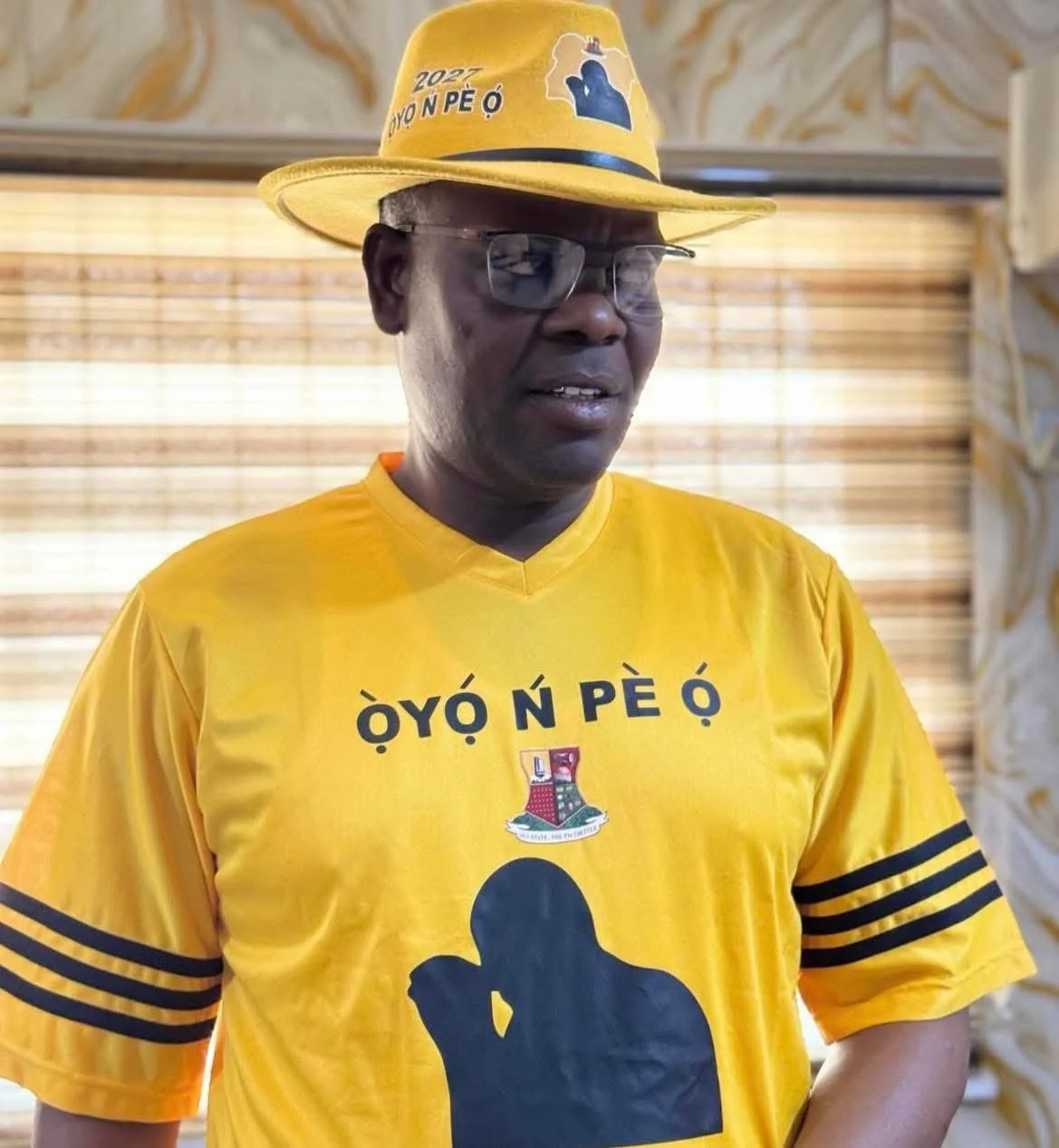
On January 17, 2026, the Ibadan-based media entrepreneur formally declared his intention to contest the 2027 Oyo State governorship election under the Accord party. The announcement, held at Obafemi Awolowo Stadium, drew supporters from across the state and marked his transition from media influence to political ambition. For observers of Oyo politics, the event signaled more than the entry of another aspirant; it heralded the arrival of a non-traditional actor into a political arena long dominated by entrenched interests, regional hierarchies, and carefully negotiated alliances.
Addressing the crowd, Hamzat stated that his decision was driven by public demand. He dismissed speculation that his political movement, ‘Oyo N Pe O’, was a bargaining tool, announcing its formal merger with Accord as a platform to contest power in 2027. Party leaders described his entry as a strategic boost, citing his grassroots reach and popularity as assets capable of expanding the party’s appeal beyond its traditional base.
The symbolism was unmistakable: a media figure attempting to translate years of public engagement into electoral relevance within a system historically privileging structure over sentiment and organisation over enthusiasm. Yet Hamzat’s emergence represents more than personal ambition; it signals a subtle but potentially transformative shift in Oyo State politics.
For decades, Oyo’s political landscape has been shaped by entrenched party structures, elite consensus, and negotiated alliances across its geopolitical zones: Ibadan, Ibarapa, Ogbomoso, Oke Ogun, and Oyo. Electoral outcomes have often hinged less on public enthusiasm than on internal party dynamics, zoning arrangements, and behind-the-scenes bargaining. Power has traditionally circulated within a relatively closed political class, reinforced by patronage networks and institutional continuity.
However, as the 2027 election approaches, these traditional formulas appear increasingly insufficient. Rising economic pressures, persistent unemployment, insecurity, and widening inequality have deepened public frustration. Governance feels distant from lived realities, while political rhetoric often fails to connect with citizens’ material concerns. At the same time, generational change, coupled with media-driven mobilisation, is altering how political legitimacy is constructed. In this context, Hamzat’s entry matters less for pedigree than for what he represents: the possibility that visibility, accessibility, and sustained engagement may rival party machinery in shaping outcomes.
Hamzat is best known as the founder of Agidigbo 88.7 FM, a radio station in Ibadan that has become a powerful platform for grassroots discourse. Broadcasting largely in Yoruba, the station amplifies the voices of traders, artisans, farmers, and ordinary citizens often excluded from elite political spaces. Its phone-in programmes, town hall discussions, and community-focused content have earned a loyal listenership across Oyo State.
In a political ecosystem where radio remains influential, especially in semi-urban and rural communities, the ability to frame narratives and reflect public sentiment carries considerable weight. Unlike social media, which is often fragmented and polarising, local radio fosters intimacy and continuity, allowing broadcasters to build long-term trust. Political analysts argue that Hamzat’s media background gives him an intuitive understanding of public mood, a valuable asset in an era of voter volatility. Years of moderating debates and engaging communities have positioned him as a familiar presence in households across the state.
Yet history cautions against assuming media influence automatically converts to votes. Popularity and organisation do not always converge; elections are ultimately won through networks, alliances, and turnout machinery. Hamzat’s appeal is tied to a broader sense of voter restlessness. Across Oyo State, fatigue with familiar political faces and repetitive campaign promises is increasingly evident. Traditional loyalties are weakening, replaced by expectations of authenticity, accessibility, and responsiveness. Political identity is now shaped more by perceived sincerity than inherited partisan allegiance.
Hamzat’s persona – direct, conversational, and rooted in local idioms- contrasts sharply with the often distant style of mainstream politicians. To supporters, he embodies proximity; to critics, he represents populism without tested governance credentials. Both perspectives highlight the tension between established political norms and emerging voter expectations.
One of the central questions for Hamzat is party structure. Oyo politics remains heavily party-driven, with established platforms wielding deep organisational networks, financial resources, and experienced operatives. These structures are particularly decisive during primaries, where candidacies are often settled before voters engage. Party loyalty, internal negotiations, and elite endorsements continue to shape outcomes.
Hamzat’s alignment with a smaller platform has been interpreted in contrasting ways. Some view it as a strategic bypass of entrenched hierarchies; others see it as a limitation, given smaller parties’ historical difficulty winning statewide elections. Without broad alliances or defections, third-party efforts face steep odds. Yet the rise of alternative platforms also reflects dissatisfaction within major parties. Internal disputes, zoning controversies, and leadership struggles have created openings for outsiders to gain visibility and reshape agendas.
Oyo State’s political history is also deeply regional. Informal power rotation shapes expectations across the state’s zones. While Hamzat’s support appears strong in Ibadan, statewide success requires meaningful penetration into Oke Ogun, Ogbomoso,Ibarapa and Oyo zones. Name recognition alone does not guarantee trust across diverse communities.
The state’s political firmament remains populated by veteran power brokers who have shaped outcomes across successive cycles. Past governors’ trajectories illustrate this pattern: Bola Ige and Omololu Olunloyo rose from commissioner roles; Lam Adesina combined activism with legislative experience; Sen. Rashidi Ladoja emerged from NADECO and the Senate; Otunba Adebayo Alao-Akala advanced through local government and deputy governorship; Abiola Ajimobi came via the Senate; and the incumbent governor tested his appeal across multiple parties before winning in 2019. These pathways underscore the resilience of established structures and the advantages historically enjoyed by insiders.
Scholars and commentators remain divided on Hamzat’s prospects. Some argue that popularity without political tutelage is insufficient. Dr. Adebukola Ayoola of the University of Ilesa notes, “Winning elections in Nigeria is determined by political structures, not media popularity. Mass appeal does not automatically translate to votes.” She suggests that Hamzat might benefit from contesting a lower office to gain administrative experience.
Similarly, Prof. Gbade Ojo, former Head of Political Science at the University of Ilorin, emphasises the difference between governance and broadcasting: “Hamzat has the right to aspire, but navigating the political terrain is another matter. Beyond money, he must confront the structures of both the APC and PDP.”
Others highlight precedents where media professionals successfully transitioned into politics. Prof. Olabode Lucas, a socio-political commentator, observes, “In many democracies, broadcasters and editors have used their platforms as pedestals to political prominence. In Nigeria, Jakande and Ali Ciroma exemplify this pathway.” Yet he cautions that name recognition is insufficient; a well-oiled political machine and financial resources remain crucial.
Veteran broadcaster and former Nigerian Ambassador Dr. Yemi Farounbi points to instances where non-mainstream candidates have broken through entrenched systems.
“I have watched the emergence of non-mainstream candidates who succeeded because they carried huge followership from their original platforms. Sometimes they were victims of imposition or lack of internal democracy. Someone like Segun Mimiko succeeded because he had followers willing to move with him,” Farounbi said.
Supporters within Accord are equally optimistic. Party chieftain Seun Adelore argues that Hamzat’s candidacy is already unsettling the establishment: “His followership cuts across the state. What we saw at Liberty Stadium was just a glimpse of what is coming”
On concerns about funding and experience, Adelore dismissed fears that Hamzat lacked the capacity to govern. “Governance is not a one-man affair. He will assemble competent experts. People will rally around him, just as we saw in other recent political movements,” he said.
As the countdown to 2027 continues, the central question may not simply be whether Oriyomi Hamzat will win, but whether the forces he embodies, grassroots engagement, media-driven visibility, and voter restlessness, will permanently reshape political contestation in Oyo State. His candidacy reflects a broader transformation: the rising significance of public trust, direct engagement, and media credibility in an electoral ecosystem long dominated by party hierarchies and elite negotiation.
With Hamzat’s determination to challenge the political order, can the currency of popularity, cultivated through media and community connection, match the entrenched power of political machines? The 2027 election will not only test his personal appeal but may also illuminate the evolving relationship between citizens, media, and governance in Oyo State.
END