













By Rotimi Agboluaje
A renowned Professor of International Relations, Prof. Alade Fawole, has warned that no amount of foreign intervention can resolve Nigeria’s domestic security challenges, urging Nigerians to prioritize home-grown solutions grounded in good governance, institutional reforms, and national unity.


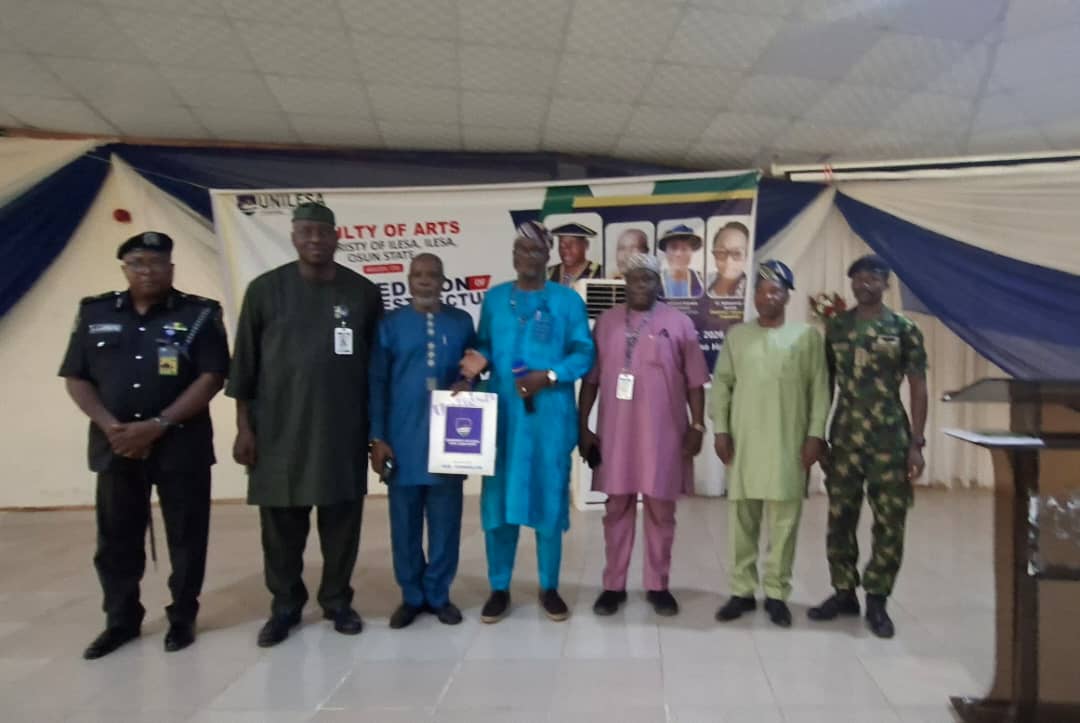
Fawole delivered the message during the maiden annual guest lecture organized by the Faculty of Arts, University of Ilesa, Osun State, themed: “The Nigerian Security Quagmire and External Intervention: Implications, Lessons and the Way Forward.”
Speaking on foreign involvement in Nigeria’s security, Fawole described the December 2025, US bombing of alleged terrorist bases in Sokoto State—which reportedly caused collateral damage in Offa, Kwara State—as a violation of Nigeria’s territorial integrity and sovereignty.
“The US intervention is transactional, not humanitarian. External involvement of this nature carries serious consequences for national security and unity,” he said, adding that Nigerians themselves contribute to conditions for foreign interference through propaganda and the “demarketing” of their own country.
He dismissed allegations of an anti-Christian genocide in Nigeria, describing them as opportunistic claims exploited by foreign actors to justify unilateral military actions.
Fawole called for confidence in the Nigerian Armed Forces to handle domestic insecurity and stressed that foreign intervention, no matter how well-intentioned, cannot substitute for proactive domestic governance.
Highlighting Nigeria’s multidimensional security challenges, including terrorism, insurgency, banditry, kidnapping, economic sabotage in the Niger Delta, land-grabbing, and maritime criminality in the Gulf of Guinea, Fawole argued that each threat requires a tailored, strategic response rather than a “one-size-fits-all” approach.
“External actors are rarely neutral or benevolent. Their interventions often worsen conflicts rather than resolve them,” he said, warning that foreign involvement could escalate violence, destabilize communities, and complicate counter-terrorism efforts.
The professor emphasised the importance of strengthening governance, investing in education, rehabilitating conflict-affected areas, and ensuring justice for victims as the most sustainable ways to restore peace and security in Nigeria.
Earlier, the Vice-Chancellor of the University, Prof. Taiwo Olufemi Asaolu, reinforced Fawole’s message, advocating for comprehensive, home-grown solutions. He said foreign assistance might provide temporary relief, but enduring peace depends on internal reforms and institutional strengthening.
Describing Nigeria as the “Giant of Africa,” Asaolu noted that the country faces insurgency in the North-East, banditry in the North-West, communal clashes in the Middle Belt, separatist agitations in the South-East, and cyber-related threats. He cited the 2014 Chibok schoolgirls abduction as exposing weaknesses in governance and intelligence coordination, which drew international intervention.
While acknowledging the role of regional and international cooperation, including ECOWAS and UN agencies, Asaolu questioned the long-term consequences of foreign intervention, asking: “How do we balance sovereignty with collaboration? At what point does assistance become dependency?”
He argued that insecurity in Nigeria is deeply rooted in unemployment, weak institutions, corruption, social injustice, and erosion of public trust. “Where governance fails and young people see no pathway to dignity and economic inclusion, extremist ideologies and criminal networks will inevitably find fertile ground,” he said.
Asaolu stressed that security is sustained not only by arms but by ideas, culture, and dialogue. He underscored the role of the humanities in understanding and resolving national challenges and called on academic institutions to generate research that informs public policy.
The Vice-Chancellor also advocated a multidimensional approach, including security sector reform, community policing, youth empowerment, economic diversification, and transparent governance.
The Acting Dean of Arts, Dr. Rahman Adewale Abdul-Azeez, described the lecture as a defining moment for the university and Nigerians, noting that insecurity is rooted not just in weapons but in history and identity.
Dr. Adebukola Ayoola, Acting Head of the Department of History and International Relations, lauded Fawole’s insights, while ACP Ademola Adebayo, representing the Osun State Commissioner of Police, and other dignitaries attended the event.