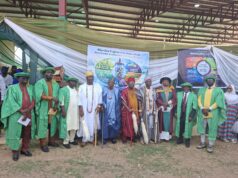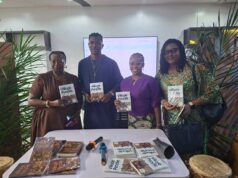








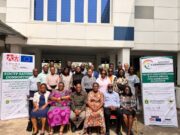






Stakeholders in the education sector have again raised concern over the deteriorating state of Nigeria’s secondary school system as the 40th anniversary reunion of the 1985 set of Gbongan/Odeomu Anglican Grammar School (Unity), Gbongan, turned into an emotional reflection on the nation’s failing educational future.
The reunion brought together alumni, school administrators and government officials, who used the occasion to lament the sharp decline in infrastructure, staffing, and learning outcomes in public schools across the country.
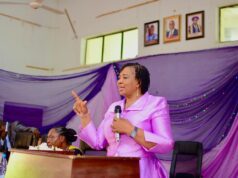
The Executive Secretary of the Senior Secondary Education Board, Mrs. Hannah Kolawole, who delivered the keynote address, said the country must urgently rescue its secondary education system if it hopes to secure its future. Describing education as the nation’s “most powerful weapon,” she warned that institutions like Gbongan/Odeomu Grammar School must not be allowed to decay any further.
“This anniversary is not merely a celebration of time, but a celebration of legacy and responsibility,” she said. She lauded the school for producing distinguished Nigerians in academics, governance, engineering, healthcare and public service, noting that such legacies are now threatened by systemic neglect.
Kolawole commended the Old Students Association for stepping in where government support has waned, highlighting projects undertaken by the group, including classroom renovations, library upgrades, borehole construction and the provision of electricity. She also noted the association’s involvement in school governance, as two alumni now serve on every Board of Governors across Osun State.
She urged the alumni to intensify investment in digital learning, vocational empowerment and values-driven education, stressing that the school must keep pace with global developments. “Your alma mater must not be left behind,” she said.
Members of the 1985 set echoed her concerns, expressing shock at the current state of the school compared to its past glory. Chartered Accountant and Vice Chairman of the Governing Board, Mr. Femi Yusuf, said the school’s infrastructural and technical gaps had become deeply troubling.
He revealed that the set had consistently supported the school by paying WAEC and JAMB fees for students, funding tutorial classes and employing teachers in critical subjects such as Physics, Chemistry, Biology and English. “One of the most meaningful things we can do is continue contributing to the development of the institution that shaped us,” Yusuf noted.
Chairman of the Planning Committee, Pastor Wale Adeleke, said the reunion was emotional for many members, given the school’s current state. He described as alarming the shortage of teachers in core subjects. “It is almost unbelievable that a school of this size does not have teachers in Physics, Computer Science and English,” he said.
Adeleke added that the decay in public schools mirrored a larger national crisis, urging alumni across the world to reorganise as the school prepares for its 70th anniversary. He stressed that while infrastructure may fail over time, investment in human capital remains critical.
Another member of the set, Pastor Funsho Popoola, warned that Nigeria’s educational decline had reached dangerous levels. He recalled the school’s former status as one of the best in the Aionian group, with well-equipped laboratories and a diverse student body, lamenting the loss of those standards.
“But today, facilities are no longer what they used to be, and there is no maintenance culture,” he said, noting that many parents now discourage their children from pursuing formal education, seeing it as unprofitable.
Popoola disclosed that three students sponsored by the alumni are currently studying Public Health, Engineering and Accountancy, with plans to bring them back next year to mentor current students. He blamed weak government oversight for the continuing decline, saying parents and communities alone cannot salvage the system.
“If a child fails to go to school, there is a limit to how far he can go in life. No one becomes truly successful on ignorance,” he said.
The reunion ended with renewed commitments from the 1985 set to scale up interventions and mobilise more support, even as stakeholders insisted that only deliberate government action and strong community involvement can halt the downward spiral in Nigeria’s secondary education system.
Advertisement