
















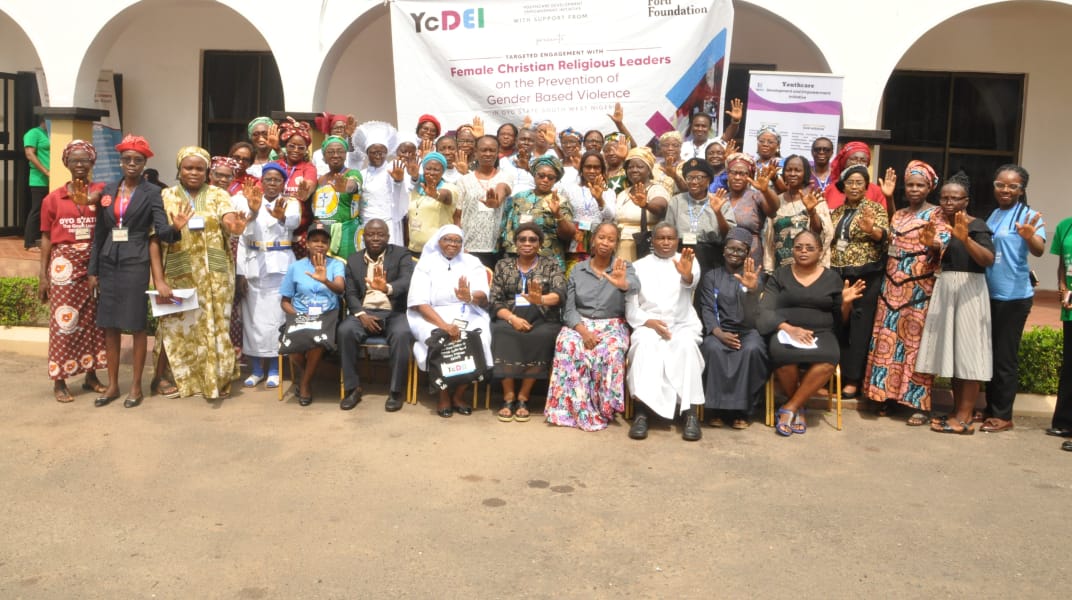
The stakeholders spoke at a four-day residential training for religious leaders in six local government areas of Ibadan organised by the Youthcare Development and Empowerment Initiative (YcDEI) with support from the Ford Foundation in Ibadan.
The Chairman of CAN in the state, Rev. Olukayode Ogundiya, warned that incidents of GBV have become widespread, stressing the need for urgent and coordinated action across communities and religious institutions.

Ogundiya said victims and concerned groups now approach the association frequently, indicating the scale of the problem.
“The issue of gender-based violence has become rampant. New groups come to meet me regularly concerning this matter, which shows the urgency and scale of the problem,” he said.
He noted that CAN has intensified advocacy, seminars and sensitisation campaigns at both state and national levels, particularly within faith-based settings, to address the challenge.
Describing the increasing attention to GBV as a call for collective responsibility, Ogundiya urged religious leaders to play active roles in safeguarding women and children.
“You may not all be pastors, but you have a role to play. Encourage and support ministers in your churches to safeguard women and children. This is a collective responsibility,” he added.
On collaboration, he declared CAN’s readiness to partner with organisations committed to promoting peace, justice and social development.
Also speaking, the Executive Director of YcDEI, Prof. Adefunke Ekine, urged female religious leaders to take the lead in combating GBV, noting their strategic roles as caregivers and moral influencers within families and communities.
She emphasised that equipping women leaders with knowledge on the causes and consequences of GBV would enable them to act as agents of prevention at the grassroots.
Ekine, however, cautioned against the misinterpretation of religious teachings to justify abuse, stressing that such practices undermine justice and dignity.
“Teachings that emphasise women’s silence or submission are often taken out of context,” she said.
Similarly, the Oyo State Commissioner for Women Affairs and Social Inclusion, Hon. Toyin Balogun, described GBV as a serious societal and moral challenge with far-reaching consequences.
Represented by Mrs. Adebukola Akinpelu, she noted that faith leaders occupy positions of trust and influence that can be leveraged to promote non-violence and social justice.
“Gender-based violence is not only a violation of human rights but also a moral issue demanding collective action. Faith leaders are uniquely positioned to champion the cause of ending violence,” she said.
Balogun reiterated the state government’s commitment to tackling GBV through policies and interventions, including the establishment of shelters, One-Stop Centres, referral systems and public awareness campaigns.
She urged participants to apply the lessons from the training within their congregations and communities, stressing that religious institutions must become safe spaces for victims.
Also contributing, a facilitator, Ven. Yemi Alade of the Anglican Communion called on church leaders to be proactive in addressing abuse cases, urging them to speak up and empower victims.
“If you see something, say something. Women must be encouraged to speak out, and the Church must provide safe spaces and support systems,” he said.
Other stakeholders, including Mrs. Rita Ayodele of WOWICAN and Ven. (Dr.) Samuel Aiyegbusi of the Christian Council of Nigeria, emphasised the need for sustained collaboration between religious bodies, government and civil society organisations to tackle GBV and support survivors.
They stressed that continuous advocacy, education and community-driven initiatives are essential to reversing the trend and building safer, more inclusive societies.