
















By Eniola Akinsipe
Health experts have called for the adoption of implementation research (IR) as a critical tool for improving the efficiency, equity and sustainability of health interventions, warning that many proven disease-control strategies fail to deliver expected outcomes when scaled without adequate contextual understanding.

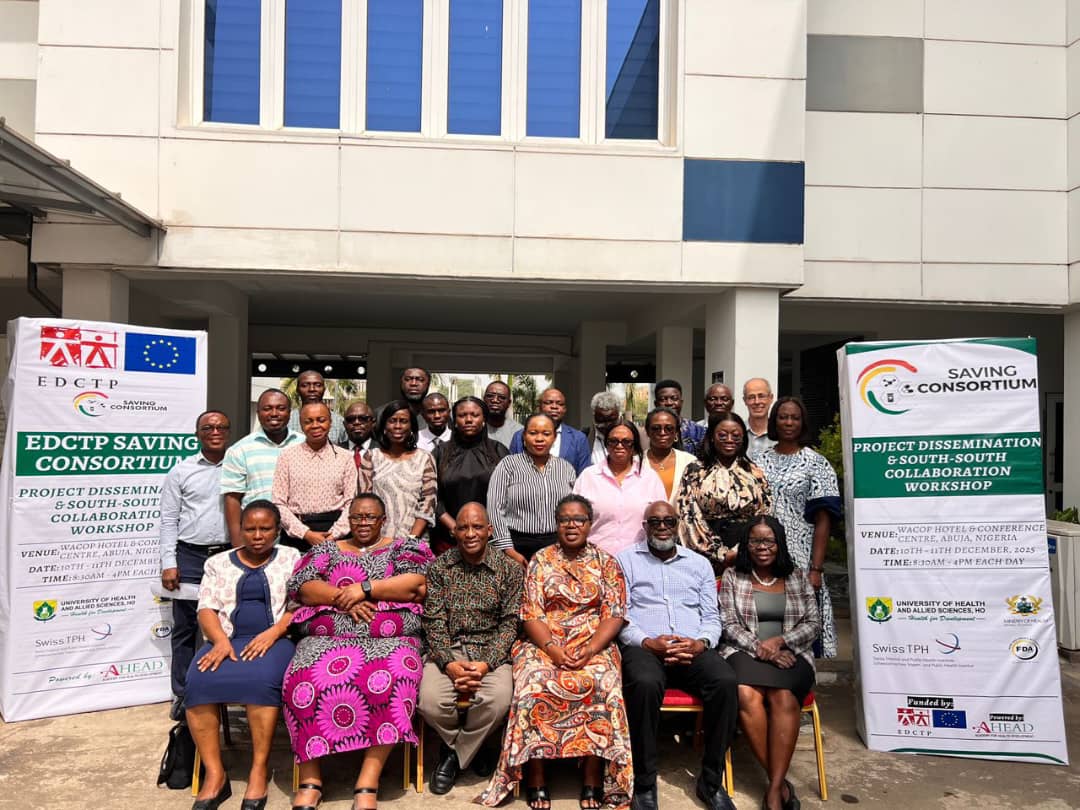
The call was made at the Project Dissemination and South-South Collaboration Workshop of the SAVING Consortium, held at WACOP Hotel, Abuja, between December 10 and 11, 2025. The workshop was organised by the Academy for Health Development (AHEAD), Nigeria.
SAVING, an acronym for Sustainable Access and Delivery of New Vaccines in Ghana, is a consortium funded by the European and Developing Countries Clinical Trials Partnership (EDCTP).
In a joint presentation titled Overview of implementation research, Professors Olumide Ogundahunsi and Tuoyo Okorosobo of the SAVING Consortium described implementation research as “a systematic approach to understanding and addressing barriers to effective and quality implementation of health interventions, strategies and policies.”
They explained that IR is demand-driven and conducted under real-life conditions, making it particularly suited to bridging the gap between evidence and practice within complex health systems.
Chair of the SAVING Consortium and principal investigator, Professor Margaret Gyapong, said implementation research is essential because health interventions that prove effective in controlled settings often fall short when deployed at scale.
“In practice, when effective disease-control tools, strategies or policies are expanded across entire systems, their health impact often does not meet expectations,” she said. “Implementation research can identify and address the bottlenecks and barriers responsible.”
Gyapong added that IR improves programme effectiveness by optimising available resources and enhancing equity across different populations and health-system contexts.
The two-day workshop featured technical sessions and panel discussions that enabled participants to exchange experiences and lessons learnt from the consortium’s four institutions and work-package leads — the Ghana Food and Drugs Authority, the Ghana Ministry of Health, the Swiss Tropical and Public Health Institute, and the University of Health and Allied Sciences, Ho.
Participants underscored the need for stronger collaboration among researchers, policymakers, healthcare providers and community representatives to ensure that implementation research produces contextually relevant and sustainable solutions.
Highlighting the consortium’s experience in capacity building, Professor Evelyn Korkor Ansah stressed the importance of strengthening institutional capacity for implementation research.
She said SAVING had deliberately built the capacity of partner institutions to conduct IR and argued that such efforts should be institutionalised. “Capacity building in implementation research should be encouraged and made a regular exercise,” she said.
The workshop, attended by academics, government officials, non-governmental organisations and members of the media, concluded that embedding implementation research in health programmes would significantly improve the efficient and sustainable delivery of interventions.
President of AHEAD, Professor Adesegun Fatusi, disclosed that the academy plans to organise another implementation research training workshop in the first quarter of 2026.
According to him, the workshop will provide a platform for interdisciplinary dialogue, encourage the sharing of implementation challenges and place special emphasis on tailoring interventions to local cultural and health-system realities, a factor widely acknowledged as critical to successful health outcomes.