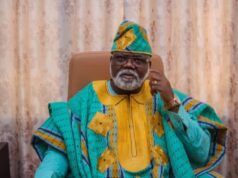

















A former Nigerian Ambassador to the Philippines, Dr. Yemi Farounbi, on Thursday warned that any decision by Oyo State Governor, Seyi Makinde, to defect to the All Progressives Congress (APC) would amount to the final nail in the coffin of the Peoples Democratic Party (PDP), describing the opposition party as already suffering a “technical death”.
Farounbi was reacting to reports where Makinde was seen visiting President Bola Tinubu of the APC in Abuja.

The elder statesman said the deepening internal crisis within the PDP has pushed the party to the brink, noting that ongoing leadership disputes and legal battles have weakened its capacity to function as a credible national opposition.
According to him, the uncertainty surrounding court cases involving the party has further eroded confidence among members, fuelling the wave of defections across the country.
He argued that Makinde remains one of the last major pillars sustaining hope within the PDP, particularly among those who see the Oyo State governor as a potential future presidential candidate. Should Makinde defect now, Farounbi said, it would effectively seal the party’s fate and confirm its collapse as a viable political force.
“The moment Makinde leaves, the PDP as a national party is finished,” he said, adding that such a development would have far-reaching implications beyond the party itself.
Farounbi warned that the demise of the PDP would signal a dangerous contraction of Nigeria’s democratic space, insisting that multi-party democracy is already on life support. With the ruling APC consolidating power, he said the weakness or collapse of opposition parties would leave the country drifting towards a de facto one-party system.
He noted that other parties lack the stability or structure required to fill the vacuum. The New Nigeria People’s Party (NNPP), he said, remains fragile, even in Kano State, where it holds the governorship.
According to Farounbi, the party is internally weakened, with its governor appearing politically unsettled within its own platform.
The Labour Party (LP), which surged in popularity during the 2023 general elections, was also described as being mired in crisis, struggling with leadership disputes and declining cohesion. Farounbi observed that the mass enthusiasm that followed Peter Obi’s presidential bid has largely faded, further diminishing the party’s national influence.
On emerging alternatives, he said the African Democratic Congress (ADC) is yet to prove itself as a credible national platform. Unlike the APC, which was formed through the merger of several established parties with strong grassroots followership, Farounbi said the ADC is largely a collection of individuals rather than organised political movements.
While acknowledging that some of the figures associated with the ADC are politically solid, he added that others are merely “big names” without real grassroots support or ideological clarity.
Farounbi added that if Makinde defects to the APC, it would not only accelerate the collapse of the PDP but also underscore the shrinking prospects for genuine multi-party democracy in Nigeria, leaving the APC as the dominant, and possibly unchallenged, political force in the country.