

















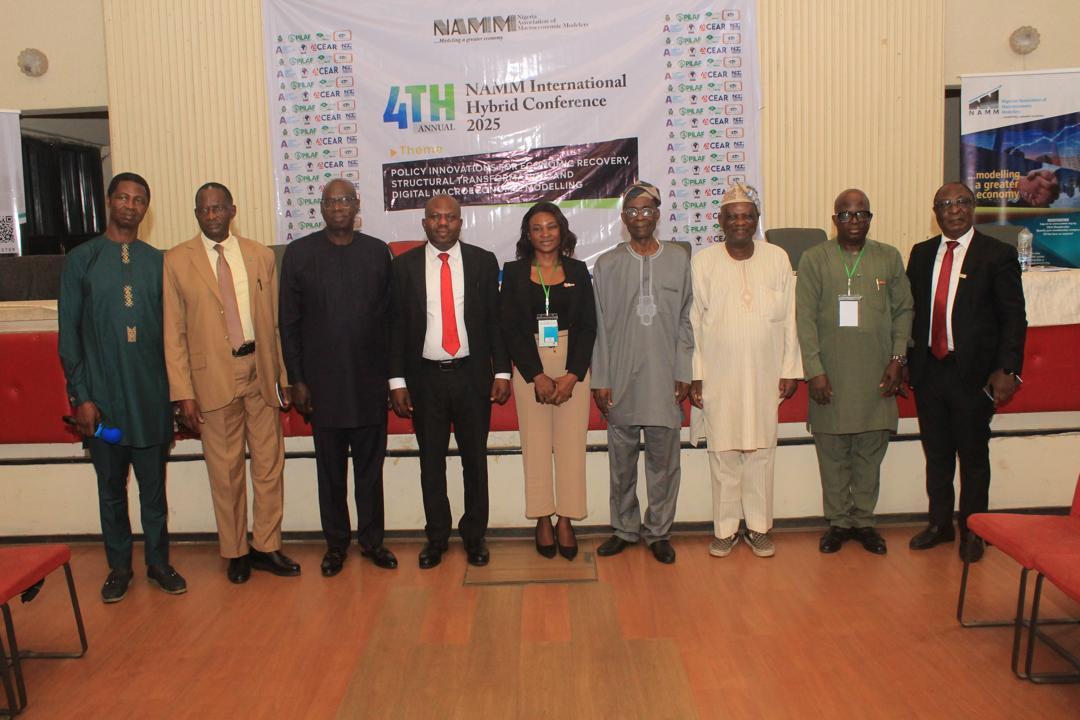
The Nigeria Association of Macroeconomic Modellers (NAMM) has called for the development of structural transformation models that reflect Nigeria’s unique economic complexities, warning that continued reliance on imported frameworks will hinder effective policymaking and long-term growth.
At the fourth Annual NAMM International Hybrid Conference held on Wednesday at the University of Ibadan, leading economists and policy experts stressed that Nigeria’s development challenges can only be addressed through analytical tools rooted in the country’s structural, social and institutional realities.

The conference assembled scholars, policymakers and data scientists to deliberate on modelling innovations capable of driving Nigeria’s structural transformation and supporting evidence-based economic planning.
Former Director of Statistics/Monetary Policy at the Central Bank of Nigeria (CBN), Dr. Mohammed Tumala, said Nigeria’s recurring macroeconomic instability is a symptom of deep-seated structural imbalances that cannot be solved with generic or externally designed models.
“Nigeria’s persistent macroeconomic vulnerabilities are symptoms of an underlying structural imbalance. Our fragile, commodity-driven recoveries falter because we have not engineered the fundamental transformation required for enduring prosperity,” he said.
Tumala, an experienced statistician and macroeconomic researcher, argued that Nigeria must embrace data-driven and evidence-based policymaking anchored on local research, digital innovation and robust statistical systems.
According to him, the global economy is shifting rapidly due to digitisation, with wealth increasingly concentrated in intangible assets. He warned that Nigeria risks being left behind unless it upgrades its statistical infrastructure, technology and human capital to support modern modelling.
“The global economy has been transitioning mainly because of digitisation.Wealth is being redistributed with increasing skewness in favour of holders of intangible assets. Nigeria must adapt or lag the transition,” he noted.
Tumala, who pioneered text-mining techniques for analysing monetary policy communication and created an Economic Policy Uncertainty Index at the CBN, added that previous failures to anticipate major global shocks, including the 2008 financial crisis,stemmed more from inadequate modelling tools than from data gaps.
President of NAMM, Prof. Phillip Alege, said the association is committed to producing a flagship Nigerian structural transformation model capable of guiding policy in a rapidly changing world.
“Macroeconomic models guide our understanding of growth, stability and policy design. Nigeria and Africa cannot escape modern modelling approaches in the face of evolving development challenges,” he said.
Alege noted that global uncertainty has surged to an unprecedented level and is unlikely to ease in the near term, stressing the need for dynamic models that incorporate behavioural, institutional and political economy dimensions, as well as informal sector realities and social variables.
“This conference is not about lamenting the past; it is about building tools for the next 65 years,” he added.
Participants resolved that Nigeria must adopt modern modelling approaches, such as digital data streams, agent-based modelling and integrated statistical systems, to effectively capture the complexities of its economy and chart sustainable development pathways.