










From Political Desk, Ibadan
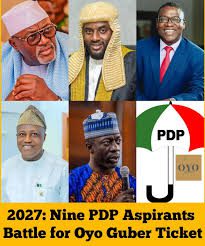
As the race toward the 2027 governorship election in Oyo State gradually gathers momentum, the internal dynamics within the Peoples Democratic Party (PDP) are beginning to take shape.
While no official primaries have been conducted, the perceived strengths and weaknesses of likely aspirants are already being framed in political discourse, both within party circles and the broader public space.
These “frames” are not merely casual observations; they represent strategic narratives that could influence voter perception, party alignment, and ultimately, candidate viability. Below is a critical examination of leading figures and how their candidacies are being interpreted.
Bimbo Adekanmbi: The Status Quo and Stagnation Narrative
Bimbo Adekanmbi is often portrayed as a symbol of continuity with the established political order. His long-standing involvement in party structures places him firmly within the “old guard,” raising concerns among some stakeholders about resistance to reform. Critics argue that such deep entrenchment may perpetuate existing inefficiencies rather than inspire innovation. In a political climate where voters increasingly demand change, this framing could position him as a candidate of stability, but also of stagnation.
Nureni Adeniran: Inexperience and Parochial Reach
For Nureni Adeniran, the dominant narrative centres on limited exposure beyond grassroots politics. While his strength at the ward level is acknowledged, questions remain about his capacity to scale governance across a complex state like Oyo.
This framing suggests a candidate whose influence may not yet transcend local political ecosystems, potentially limiting his appeal in a statewide contest.
Adebo Ogundoyin: Youthful Energy or Recklessness?
Adebo Ogundoyin represents a younger generation of politicians, bringing energy and vibrancy to the race. However, this same youthfulness is being framed by critics as impulsiveness and political naivety. The concern here lies in whether enthusiasm can translate into effective governance, especially in navigating the intricate political and administrative challenges of Oyo State.
Stanley Adedeji Olajide: The Out-of-Touch Intellectual
Stanley Adedeji Olajide is often associated with technocratic competence and intellectual depth. Yet, this strength doubles as a perceived weakness in political framing. Opponents argue that his approach may be overly academic, potentially alienating grassroots voters who prioritize relatability and practical engagement over theoretical expertise.
Adebo Akande: overly technocrat without strong political base
Despite his notable impacts in agriculture and development, Adebo Akande’s relatively low political profile and newness to partisan politics may affect his chances, even as his global partnerships, including with the World Bank, continue to draw attention. In an era where political freshness often drives voter enthusiasm, this framing could limit his ability to galvanize new support.
Beulah Adeoye: The Symbolic Candidate Debate
Beulah Adeoye enters the conversation amid discussions of representation and inclusivity. However, critics frame his candidacy as largely symbolic, suggesting a focus on identity politics rather than substantive policy. This perception, if unchallenged, could overshadow his competence and policy ideas, reducing his campaign to a narrative of tokenism.
Taofeek Arapaja: A Single-Issue Focus?
Taofeek Arapaja is widely recognised for his experience, yet his candidacy is being framed as narrowly focused, particularly on economic matters. While economic reform is critical, the concern is that an overly concentrated agenda may neglect other essential aspects of governance, thereby limiting his overall appeal.
Segun Ogunwuyi: The Technocrat Without a Base
For Segun Ogunwuyi, competence is not in question. However, the prevailing narrative casts him as lacking grassroots political machinery. In a political environment where voter mobilisation is key, this perceived disconnect from the electorate could pose a significant challenge.
Olufemi Ajadi: The Unrealistic Reformist
Olufemi Ajadi is framed as an ambitious reformer whose ideas may outpace practical realities. His proposals are often seen as idealistic, raising concerns about feasibility and political acceptability. Such a narrative could alienate party elites and stakeholders essential for building consensus and executing policy.
Femi Babalola: Ethical but Inflexible
In the fluid world of politics, where negotiation and compromise are indispensable, an overly strict approach could hinder coalition-building and governance effectiveness. However, critics argue that Femi Babalola is rigid.
Narratives as Political Currency
As the 2027 race unfolds, these frames, whether fair or strategic, will play a crucial role in shaping public perception and intra-party dynamics. In politics, perception often rivals reality, and candidates must not only present their credentials but also actively counter or redefine the narratives surrounding them.
On the final analysis, the success of any aspirant within the PDP will depend on their ability to bridge perception gaps, connect with voters across Oyo State, and present a compelling vision that resonates beyond political framing.
Advertisement