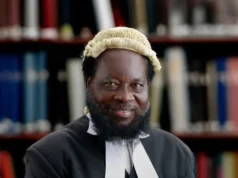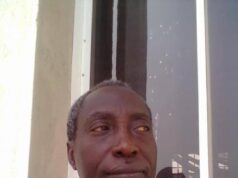
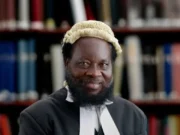
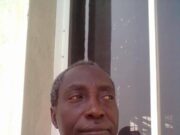









Unlike most people who have written tributes since his recent passing, I was not Professor Biodun Jeyifo’s student. Yet, I was just as fortunate to have him as a teacher and even a friend. I first heard of him from one of my lecturers at the University of Ibadan. He spoke about him in such reverent tones that I was fascinated. The second time, it was my father who told me he had been Jeyifo’s student while at the HSC. He very much admired the man and his brilliance, and he said to me, “That is my wish for you, too. To be a high-flying professor like him.” I was around 19 or so at the time, preparing to write JAMB for the third time. The thought of being anything close to such an eminent man was intriguing, even if I had no clue how that was possible.

Years later, I would finally meet him through my novel, Under the Brown Rusted Roofs. He got a copy of the book, reached out to me, and said he would like to meet me. I was delighted. When I mentioned to him that he had once taught my father, he was astonished and amused. “That makes me old enough to be a grandteacher!” he said. I remember how—contrary to my expectations that I would be intimidated by him—I was at ease in his genial presence. We talked about my book, but we also branched into talking about many other topics that lent themselves to a good conversation. Life. Poetry. Life in Nigeria. Politics. His talakawa ideology. Religion (he always said his religious persuasion was “ìwàlẹ̀sìn”). I remember that the first question he asked me was, “What does it mean to be a young person living in Nigeria today?”
Looking back now, I realise what a privilege it was for me that a man like that would dedicate time talking to someone like me who had barely seen the world. Even more remarkable is that, despite the vast age, knowledge, and experience gap between us, he was never condescending towards me. I looked up to him, and he never looked down at me. When I shared with him that my father wished I could be like him, he said it made him proud that, despite being a young teacher during the brief teaching stint, he had made a lifelong impression on a student who wanted his own daughter to take after him. When I mentioned to him that I was pursuing graduate school in the USA, he was very encouraging too. I have gone back to read our email exchanges from as far back as 2008, when I first knew him, and I was surprised by how many of them were pep talks at a time when I was in a very uncertain place. He had intuited—and rightly too—that I was grappling with despair, and he kept sending encouraging messages until that phase passed.
In Lagos, he usually stayed in Victoria Island. There was a beach close to the house—I cannot recall the name now. When I casually remarked that I liked beaches, although I had only visited one in my life as a child—and I could only watch from a distance because the relatives who took us to the Bar Beach were afraid of water—he offered to walk with me to the place. He was generous in big and small things.
When I moved to the USA for graduate school, the pressures of the transition made it hard to sustain relationships, so we only kept in touch by email. In 2016, I got a summer fellowship to Harvard, which afforded me the chance to see him again. He was quite happy to see all the progress I had made. As always, he offered to help with my research or whatever I needed to succeed. We did not see each other again until 2019, when I visited him in Ibadan. He had expected me to come with my children so he could meet them, but why did I show up alone? I told him that my children could be as excitable as feral hogs unleashed on a sugar cane farm, and I would not want them turning his house upside down. He swept his hand at the sparsely furnished living room—enduring evidence of his lifelong commitment to an anti-materialist lifestyle—and said, “There is nothing here for them to turn upside down. You can bring them whenever you want.”
I promised to visit him again the following year, but COVID-19 happened. Communication slowed down and even became sparse. At some point, emails started going unanswered. I wanted to make a phone call, but I could not find his number on my phone. I have this habit of saving people’s numbers with a code name so that if my phone ever gets lost, my friends will not be exposed to scammers. I had forgotten how I saved his number.
When I saw the news report of his 80th birthday in January, it occurred to me that I could ask Uncle Kunle Ajibade for his phone number. I finally retrieved it and sent him a message. The following day, he responded. He promised to call me after the Nigeria-Morocco match. The moment the match ended, I dialled his number. He answered, “Àdùnní, wọn ò tí gba tán, ní sùúrù. Mà pè ẹ́, má worry.” He finally called after the penalty shootout. His voice on the phone sounded as strong as ever. I told him he did not sound 80 at all.
He responded that although he had had health challenges, he was doing well. He always joked that, at his age, he was at the departure lounge—the liminal space before he makes his exit from the world—but he had been there for as long as he could remember, so we need not fear he was about to drop dead. He mentioned it again in January when we talked. “But I am still here on this side,” he said. He told me he planned to be in the USA in February, when the winter would have thawed, because he was no longer as tolerant of the Boston cold. I promised to come see him when he returned. I had some international trips scheduled, but I should be back by the 21st of February. Just give me a time and date, I told him, and I will be on the airplane the very next day. He promised to do so. I was going to tell him how much his old book, The Yoruba Popular Travelling Theatre of Nigeria, had inspired my ongoing work. I was looking forward to hearing from him on several issues.
On Wednesday, February 11, I was waiting for the Uber that would take me to the airport, ready to begin those same trips, when the news flashed across my phone that he was dead. He had died just that morning. My legs wobbled. Dead? How could he be dead? We had an appointment, and he was supposed to call me! But that was not to be. Death makes no appointments with anyone. Whenever Death is ready, Death comes calling; we will have no choice but to stand up from the departure lounge and answer that final boarding call.
So, yes, Professor Biodun Jeyifo, grandteacher and grand human, farewell, as you embark on your journey to the great beyond.