















The United Nations Children’s Fund (UNICEF) and governments of South-West states have restated their commitment to strengthening coordinated action on nutrition through an integrated multi-sectoral intervention framework aimed at addressing malnutrition and improving child survival outcomes.
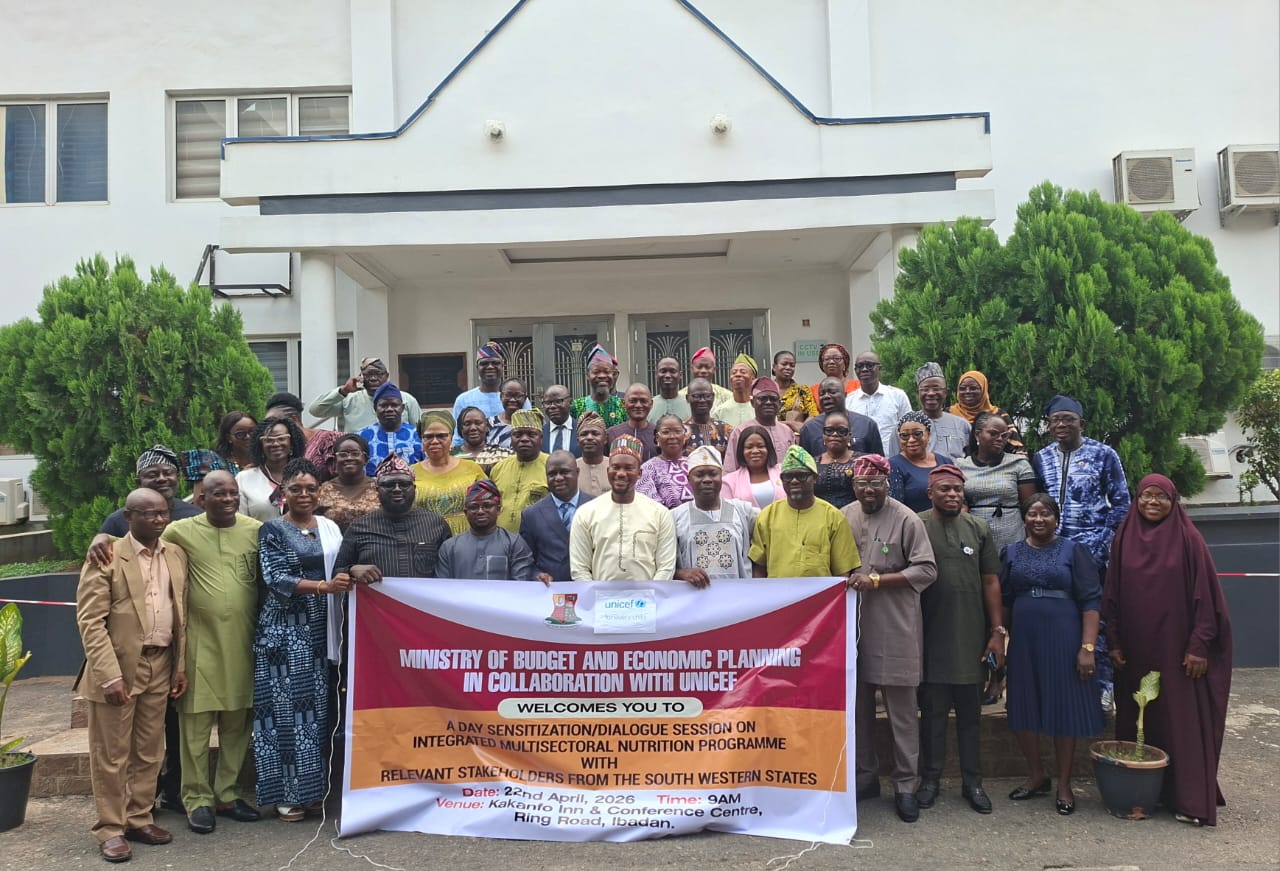
The renewed collaboration was emphasised at a one-day South-West regional workshop on the operationalisation of Integrated Multisectoral Nutrition Intervention and the N-774 Initiative, held in Ibadan, Oyo State.


The summit, convened by the Oyo State Ministry of Budget and Economic Planning in partnership with UNICEF Nigeria, brought together Permanent Secretaries of relevant ministries, Executive Secretaries of State Primary Health Care Boards, and key stakeholders from Ekiti, Lagos, Ogun, Ondo, Osun, and Oyo States.
Speaking on the theme, Integrated Multisectoral Nutrition Programming in South-West States, UNICEF Programme Manager in Nigeria, Lagos Field Office, Muhammad Okorie, stressed that nutrition remains a fundamental child rights issue with long-term implications for human capital development.
Okorie warned that poor nutrition, particularly within the first 1,000 days of life, leads to irreversible cognitive and developmental damage.
“Nutrition is one of those very important child rights issues that must be addressed. The consequence of not taking nutrition seriously can lead to a child being deprived of vital intellectual capabilities, and unfortunately, these are not reversible,” Okorie said.
He identified stunting as a major public health challenge in the region, noting that it directly impairs intellectual development and long-term productivity.
Okorie explained that the Federal Government’s N-774 initiative provides a structured coordination platform across federal, state, and local government levels to improve planning, budgeting, and accountability in nutrition governance.
He further highlighted the Child Nutrition Fund (CNF) as a critical financing mechanism designed to support states through matching grants for nutrition commodities, urging state governments to take full advantage of the initiative.
“For example, if a state commits N100 million to nutrition commodities, UNICEF matches it, making it N200 million. This is low-hanging fruit that every state should take advantage of,” he said.
He disclosed that Oyo State has already accessed the fund, with matching contributions deployed for procurement and distribution of nutrition commodities, while encouraging other states to scale up implementation.
Okorie also called for sustained annual budgetary provisions for the CNF to ensure continuity and impact, noting that donor funding is not permanent.
“The funding environment is ever-changing. States must prioritise domestic investment in nutrition. The cost of inaction is far greater,” he added.
In her remarks, the Chairman, Egbeda Local Government and Association of Local Government of Nigeria [ALGON] Chairman in Ogun State, Dr. Folasade Adeyemo, described nutrition as central to human development and economic productivity.
“Without proper nutrition, there will not be proper health, education outcomes will suffer, and children cannot function effectively. Nutrition is multi-faceted and must be tackled headlong,” she said, adding that local governments were fully committed to supporting the N-774 framework.
Similarly, Chairman of the House Committee on Nutrition and Food Security in the Oyo State House of Assembly, Dr. Abiodun Babalola, said nutrition is directly linked to human capital development and economic growth.
“Good nutrition impacts human capacity and has a direct nexus with economic development. This is why Oyo State is partnering with organisations like UNICEF,” he said.
In his welcome address, the Permanent Secretary, Oyo State Ministry of Budget and Economic Planning, Tunde Ayanleke, who represented the Commissioner, Seun Ashamu, described the workshop as timely, noting that malnutrition remains a major challenge requiring coordinated, multisectoral response.
He reaffirmed the state government’s commitment to reducing malnutrition through sustained investment in the Child Nutrition Fund and strengthened collaboration with development partners.
Ayanleke said the workshop was designed to deepen understanding of the N-774 initiative, strengthen coordination mechanisms across states, and develop actionable roadmaps for improved nutrition financing and implementation.
He urged participants to ensure that outcomes from the engagement translate into policy and budgetary actions across the region.