















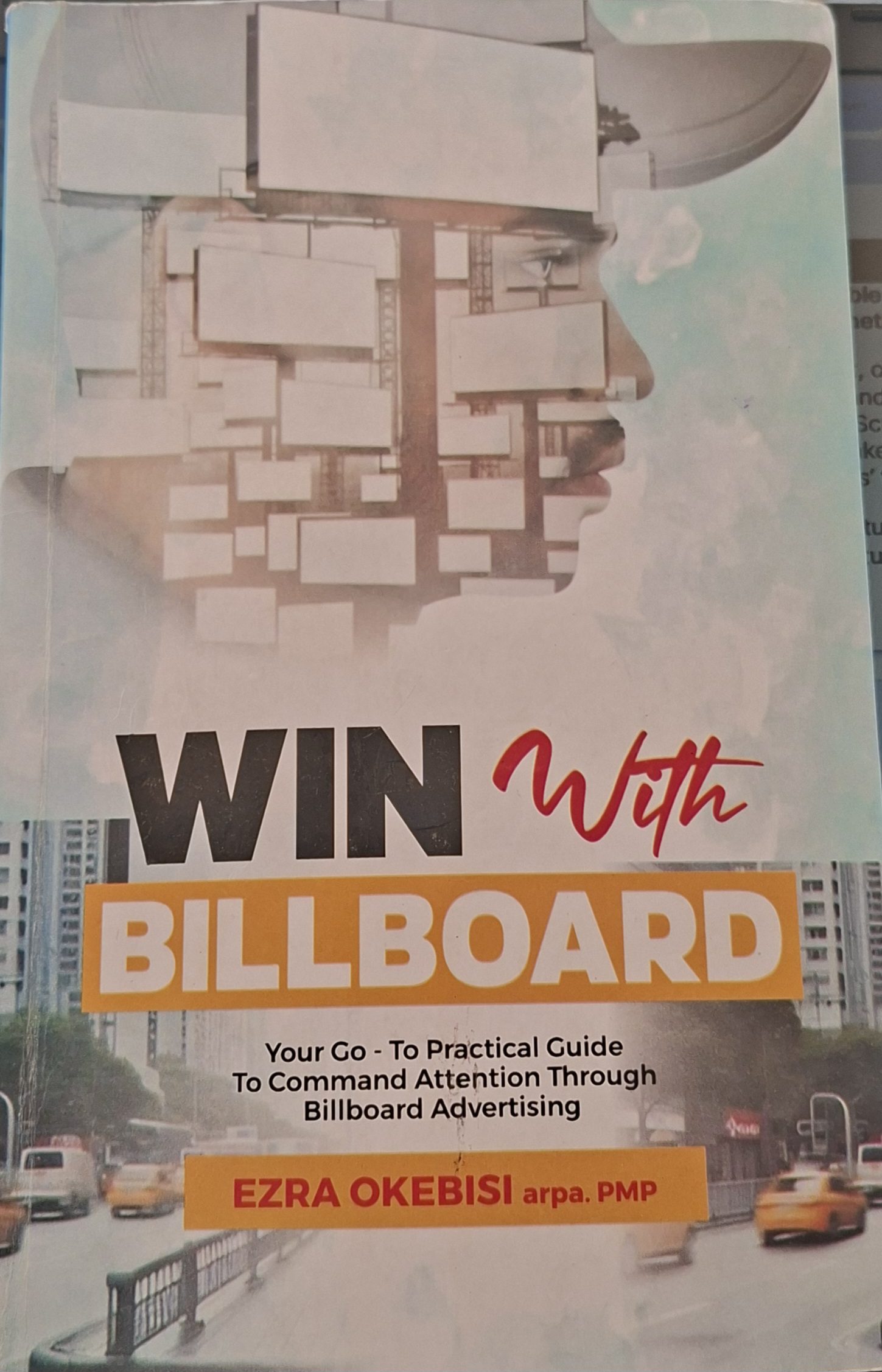
“Win With Billboard,” a 110-page professional guide authored by marketing communication expert, Ezra Okebisi, presents a practical and experience-driven roadmap to success in Out-of-Home (OOH) advertising.
Structured into 15 concise chapters, the book blends personal entrepreneurial experience with industry insights, offering readers both theoretical guidance and real-world application.


From the opening chapter, Okebisi situates the reader within his entrepreneurial journey, tracing how he began in 2018 with a fumigation business and experimented with low-cost visibility strategies such as stickers and flyer distribution. These early efforts, he explains, laid the groundwork for his entry into the advertising industry.
Through grassroots promotional methods, including street-level distribution and mobile visibility tactics, he gradually transitioned into larger advertising engagements, working with a construction firm and a radio station. These experiences eventually led to the establishment of Kloud 9 Media and later a full-scale outdoor and taxi branding enterprise.
In Chapter Two, the author reflects on a pivotal innovation: the concept of “Ad Bikes” or mobile billboard bicycles. He narrates a difficult period marked by a violent attack that left him hospitalised for months and disrupted his business operations. During recovery, however, he developed renewed interest in mobile advertising systems inspired by models already operating in India and the United Kingdom. Engagement with international practitioners, he notes, helped refine his approach and strengthen the concept.
Chapter Three offers a critical business lesson on expansion and risk management. Titled “Out-of-Home Advertising: Bitter Lesson,” it warns against premature market expansion, using his unsuccessful attempt to penetrate the Lagos advertising market as a case study. According to him, lack of strong contractual foundations contributed to significant setbacks, prompting a strategic return to Ibadan where he formalised operations under CityCrier Communication Limited.
Subsequent chapters shift into technical instruction and professional guidance. Chapter Four outlines the regulatory pathway into advertising practice in Nigeria, stressing certification by the Advertising Regulatory Council of Nigeria (ARCON) and the importance of academic grounding in fields such as Mass Communication, Marketing, Public Relations, and Design.
Chapters Five and Six focus on billboard design and copywriting, emphasising simplicity, clarity, and visual impact. Okebisi argues that in outdoor advertising, effectiveness depends on immediacy of message delivery, where minimal text and strong visuals outperform verbosity.
Chapter Seven examines the importance of size and placement in billboard effectiveness, while Chapter Eight explores crafting compelling offers that convert visibility into consumer action. The author stresses the psychological dimension of advertising, where persuasion is as important as exposure.
Chapter Nine distinguishes between billboards aimed at brand awareness and those designed for direct sales activation. Chapter Ten situates advertising practice within cultural context, urging practitioners to remain sensitive to language, values, and social norms of target audiences.
Regulatory and ethical considerations dominate Chapter Eleven, which highlights compliance with safety standards, legal requirements, and operational guidelines governing billboard installations.
In Chapter Twelve, the discussion expands into digital integration, with the author arguing that modern advertising success lies in merging traditional outdoor media with digital amplification strategies. Chapter Thirteen reinforces this position using global examples, such as Audi and BMW, to demonstrate how outdoor campaigns can generate online engagement and virality.
Chapters Fourteen and Fifteen conclude the work with strategic insights on billboard location planning and industry collaboration. Okebisi identifies high-traffic areas as “sweet spots” for visibility and advocates stronger cooperation among practitioners to improve standards, expand reach, and strengthen industry resilience.
Overall, “Win with Billboard” is a practical, experience-rich manual that will appeal to advertisers, marketers, and communication professionals. Its strength lies in its simplicity, real-life case studies, and entrepreneurial perspective, making it accessible to both seasoned practitioners and beginners.
However, while the book is highly practical, it relies heavily on personal experience and would benefit from deeper theoretical engagement and comparative analysis with established advertising frameworks.
Nonetheless, it remains a valuable resource for practitioners, students preparing for ARCON, NIMN, and NIPR examinations, as well as professionals in marketing, mass communication, public relations, and graphic design.
In an industry where visibility is everything, Okebisi’s guide proves that strategy, not just scale, wins the billboard game.
ROTIMI AGBOLUAJE is an Ibadan-based journalist, Associate of Nigerian Institute of Public Relations [ANIPR], Associate Registered Practitioner in Advertising [ARPA], member of Association of Communication Scholars and Professionals of Nigeria [ACSPN] and Oyo State Public Relations Officer of the Nigerian Economic Society [NES].