















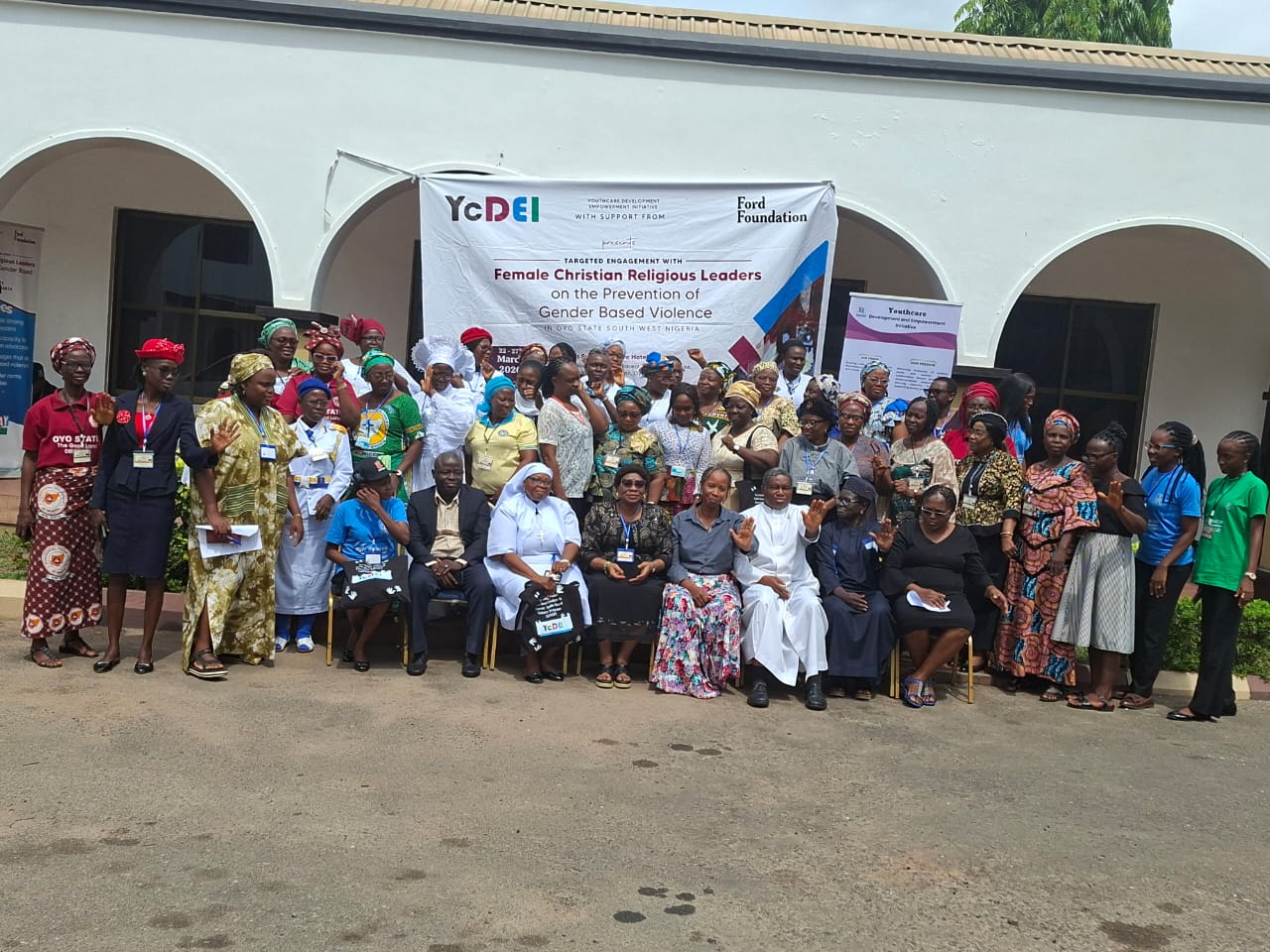
Female Christian leaders in Oyo State have been urged to take the lead in combating gender-based violence (GBV), with government officials and faith institutions warning against the misuse of scriptures to justify abuse.
The charge was given by the Oyo State Commissioner for Women Affairs and Social Inclusion, Hon. Toyin Balogun, at the opening of a four-day residential training for female religious leaders selected from six local government areas organised by the Youthcare Development and Empowerment Initiative (YcDEI), with support from the Ford Foundation, at DSC Hotel, Iyaganku, Ibadan.
Represented by the Assistant Director of the Women Programme Department, Mrs. Adebukola Akinpelu, the commissioner commended the organisers for convening the programme, describing the engagement of female religious leaders as strategic in tackling GBV.
She noted that faith leaders occupy a unique position of trust and influence, making them vital agents in promoting moral values, dignity, and non-violence.
“Gender-based violence is a serious societal problem with far-reaching consequences for women, children, families, and communities. It is not only a violation of human rights but also a moral issue demanding collective action. Faith leaders are uniquely positioned to champion the cause of ending violence by promoting messages of love, justice, and peaceful coexistence,” Balogun said.
The commissioner restated the state government’s commitment, under Governor Seyi Makinde, to tackling GBV through deliberate policies and interventions, including the establishment of One-Stop Centres, shelters for survivors, functional referral pathways, and public awareness campaigns. She urged participants to actively engage with the training and apply the lessons within their congregations and communities.
In her remarks, the Executive Director of YcDEI, Prof. Adefunke Ekine, explained that the programme brought together female religious leaders from six local government areas of Ibadan as part of the second phase of a two-year initiative.
She stressed the critical role of women as mothers, caregivers, and moral instructors. “By equipping women leaders with knowledge on the prevalence, causes, and consequences of gender-based violence, they become agents of prevention within their communities,” Prof. Ekine said.
The professor further cautioned religious leaders against misinterpreting scriptures to justify violence, noting that teachings emphasising women’s silence or submission are often taken out of context.
“Faith should promote love, care, and dignity. Religious institutions must become safe spaces where victims can speak up and receive support,” she added.
Also speaking, a facilitator, Ven. Yemi Alade of the Anglican Communion and the Anglican Compassion and Development Initiative (ACADI) urged church leaders to take proactive measures. “If you see something, say something. Women must be encouraged to speak out, and the Church must empower members through education, safe spaces, and financial support for the vulnerable,” he said.
In her remarks, Mrs. Rita Ayodele of WOWICAN, Women’s Wing of the Christian Association of Nigeria, described the programme as timely and impactful. She called on organisers to continue supporting the weak and vulnerable while strengthening the legal framework for such initiatives.
Ven. [Dr.] Samuel Aiyegbusi of the Christian Council of Nigeria emphasised the need for collaboration between churches and NGOs to support survivors. “The Church must educate members, support victims, and reintegrate survivors into society. Opportunities like this should not be missed; as the saying goes, ‘iron sharpens iron.’ Together, we can build a safer and more just society,” he said.
Advertisement