















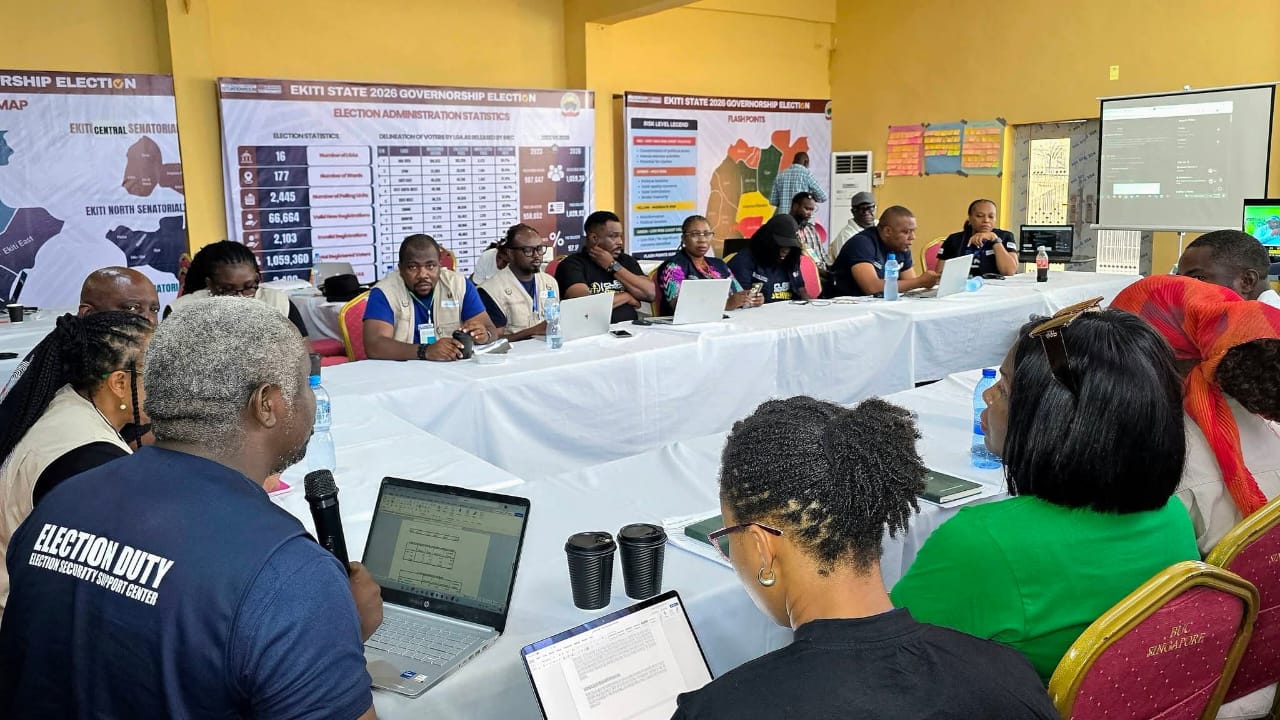
Despite largely peaceful conduct and strong security deployment during Saturday’s Ekiti State governorship election, CLEEN Foundation has expressed concern over the perceived lack of neutrality among some security personnel deployed for the poll.
In its preliminary election observation report released on Saturday, the organisation said findings from its field observers indicated that while security agencies maintained law and order across most polling units, nearly half of the officers observed were perceived as not being impartial.


This is contained in a report made available to The Guardian by the Executive Director of CLEEN Foundation, Peter Maduoma.
The report, based on observations from 60 accredited observers deployed across the 16 local government areas of the state, noted that 46.3 per cent of security personnel were rated as “not impartial at all,” a development the organisation described as troubling and capable of undermining public confidence in the electoral process.
According to CLEEN Foundation, the election was conducted amid extensive security deployment involving the Nigeria Police Force, the Nigerian Security and Civil Defence Corps (NSCDC), the Nigerian Army, the Economic and Financial Crimes Commission (EFCC) and other agencies.
The organisation, however, commended security personnel for maintaining a generally peaceful atmosphere throughout the election.
It reported that about 90 per cent of security officials arrived early at polling units, while more than 95 per cent were rated as approachable and professional in their interactions with voters.
“All observers indicated that voters felt either safe or very safe around polling centres, reflecting positively on the overall security management during the election,” the report stated.
CLEEN Foundation also observed that the majority of polling units had adequate security coverage, with over 82 per cent having at least three security personnel deployed.
However, it identified isolated gaps in deployment, citing a polling unit in Ijero Local Government Area where observers reported the absence of any security personnel.
The report further highlighted incidents of alleged vote-buying and voter inducement in some polling units, noting that security personnel and election officials intervened promptly to address the infractions.
It also documented technical challenges associated with the Bimodal Voter Accreditation System (BVAS) in several locations, although security officials were said to have helped maintain calm and order while the issues were being resolved.
CLEEN Foundation expressed concern over the attack on the Isan Police Station in Oye Local Government Area on the eve of the election, which resulted in injuries to police officers and destruction of property.
The organisation called for an independent investigation into the incident and urged security agencies to strengthen protection of critical security infrastructure during elections.
Among its recommendations, the foundation urged security agencies to introduce mandatory impartiality and neutrality training for officers deployed for election duties, enforce stricter disciplinary measures against misconduct, and adopt rotational deployment policies to minimise the risk of bias.
It also called on the Independent National Electoral Commission (INEC) to improve BVAS technical support and enhance provisions for persons with disabilities during future elections.
CLEEN Foundation concluded that although the election was largely peaceful and professionally managed, concerns about the perceived partisanship of some security personnel must be addressed to strengthen public trust in future electoral processes.