














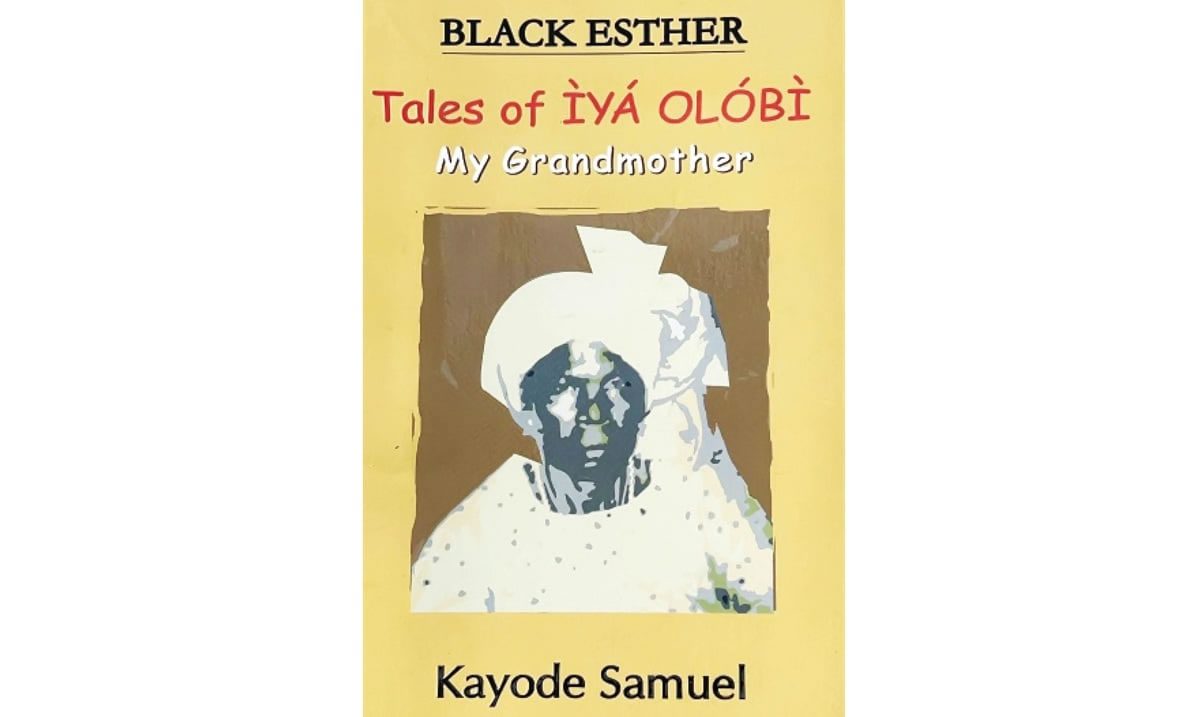
The book, Black Esther: Tales of Iya Olobi, My Grandmother, is Kayode Samuel’s childhood recollections of Iya Olobi, Mama Esther Asabi, his grandmother. A blend of the humorous, the scintillating and the pedagogic, Black Esther is truly a literature of nostalgia. It goes beyond that. It is the memoir of a parlour heroine.
From its first chapter, aptly entitled The Beginnings, the reader begins to gain insight into the main thematic concern of the book, which is the vanity of ethnic mistrust. We are introduced to the family of Samuel Edun, also known as Baba Ipaja, and his wondrous spectacle of a wife, Iya Olobi.


By the second chapter of the book, with the title, Mercy and Femi, a family tree narrative is constructed. Inside it, another construction is made. It is an ethnic rupture, what Iya Olobi would later consider an ethnic mis-alignment. For, Femi, the author’s father, who brought about that mis-alignment, went eastwards to forge a matrimony with an Omo Yibo – apologies to Iya Olobi – Mercy Adanma from Owerri in Imo State. That narrative of a perceived matrimonial mis-alignment runs through this book. It also essentializes its fifth chapter, with the title Ta’n mo se (who did I offend?).
Ìyá Olóbì traded in kolanuts in pre and post-Nigerian independence era. She was a woman whose actions provoked profound wits. Her grandson, the author, must have inherited the flakes of the spellbinding wits. Let me give you an instance. The 1975 news of a successful coup plot which caught General Yakubu Gowon, away from Nigeria, in an OAU meeting in Kampla, Uganda, with the fearsome Field Marshal Idi Amin Dada as host, brought out the best of wits from her action.
It so happened that, not too far away from the Samuel Edun family house was a notorious haven of depraved people called Kampala Hotel. It was also home to gays called the Dan Daodus, bleached-skin young men who disguised their trade by hawking special fried eggs and yam.
As a promotion of their trade in the Kampala hotel, these men wagged their mid-riffs amorously to entice both initiates and uninitiated into their licentious lifestyle. So, immediately Iya Olobi heard on radio that Gen Gowon’s government had been overthrown, she could not hide her revulsion. In her characteristic Yoruba-Egba dialect, she muttered to no one in particular, “Orisirisi! Gawanu de la joko si Kamfala titi won fi gba aduru ihun to to yen lowo re! (Can you imagine that Gowon went frolicking in Kampala while such a big position was taken away from his hands!). Iya Olobi instantly cracked the ribs of all who heard her soliloquy.
Iya Olobi was a parlour heroine. However, unlike heroines in adventure stories, she exerted spectacular and unforgettable influence within her home. This she did through gripping conversations, family maneuvering and unique control of her familial environment. Her grip, as narrated in this book, is done like an actress in a theatre. The totality of Iya Olobi’s life is a stupendous study, such that, it would be unpardonable not to immortalize the eponymous persona of Iya Olobi for posterity as the author has done.
A 158-page effort made up of 22 chapters, Black Esther opens with the author describing the task of writing Iya Olobi’s memoir as “the stuff of an exhilarating legend”. It indeed is.
Ìyá Olóbì had an unbiased reading of events, especially, once they did not pertain to the Igbo. It was only on Igbo matters that her prejudice was as constant as the Northern star.
One day, family members sought resolution to a challenge posed by her nephew, who having just graduated from learning a printing trade, had put a teenage girl in the family way. Iya Olobi’s first magisterial pronouncement, on being told of the nephew’s rascally libido, was a philosophical cause and effect equation. In same Egba dialect of hers, she said, “Eni kò bá yó, okó rè kíí le”. It means, “an erect manhood is a fallout of a full belly.” It defined her belief that, for a boy who was still being fed at home to find the energy to impregnate a girl, it was a sign of an over-fed belly.
Then, when family members wondered how the nephew could have become that aberrant, concluding that the Ìyá Olóbì nephew was seized by the spirit of wrongdoing, she totally disagreed with them. Unable to countenance the unscience behind that reasoning, Ìyá Olóbì’s retort was again a cause and effect reasoning. “Eni yìí kìí báá máa mu sìgá, ìsòro ni kí wón fi igbó seé” she said. This translated to mean, it is almost an impossibility to have someone who does not smoke cigarette get afflicted by a marijuana-smoking addiction.
Ìyá Olóbì was most times very prickly, especially on issues that had to do with Omo Yíbò. Igbo was an ethnic group she had a thousand and one concoctions about its assumed evil. You may however not blame her. Ìyá Olóbì was a willing accomplice of the then spiraling mutual mistrust between Yoruba and Igbo which gained notoriety shortly before independence. Often times, she manufactured other-wordly-like stories that ended up as ethnic profiling of the Igbo, creating a cocoon of righteousness which only her ethnicity, the Yoruba, could inhabit. Undoubtedly, she was a victim of her own animus. Daily, she lived a life that was an admixture of women wiles, humour but a powerful mastery of the power of the Yoruba language.
In pursuit of her animus against the Igbo, Iya Olobi believed Adanma, her daughter-in-law’s inability to bear more than two children for her son, in the words of her grandson, the author, “had so much to do with her Igbo provenance”. Her logic was that Igbo women were too involved in masculine jobs, so much that their femininity easily caves in at the feet of multiple child-bearing. This counteracts her own situation as a very hardworking woman, whose hardwork nevertheless resulted in her giving birth to eleven children, though only two of them eventually survived.
On Page 32 of the book, Iya Olobi again manifested her Igbo prejudice. One evening, she suddenly burst into a melancholy borne out of her usual ethnic profiling. She muttered to no one in particular, Tan’mo se, ti o fi waa je wipe Yibo ni yio wa j’ogun omo mi? (Who have I offended that it has to be an Igbo woman who will inherit my child’s property?).
While chapter two of Black Esther draws the family tree of the Eduns, as well as that of the Igbo woman whom Iya Olobi’s son got married to, its fifth chapter plots the graph of the periodic battles fought between Iya Olobi and Mercy. This was a war fought with non-kinetic weaponry, not with bullets, swords or spares, but with sharp lacerating tongues, body language of condemnation and innuendos that penetrated the skin more than bullets. The wars were fought, not on account of Mercy Adanma’s motherhood failure but Iya Olobi’s perception of her son’s mis-matrimony. This was especially due to her fabulous beliefs about the Igbo.
When Iya Olobi saw Andrian Price, her son’s British scholar researcher friend, who arrived Nigeria in the late 1960s from the University of Sussex, her prejudice, inquisitiveness and wits-provocation instantly came alive. “Imu won se wa ri kanbo bayi?” – why are their noses so funnily shaped, she asked.
Iya Olobi had this mis-biology about which women with a particular physique could carry pregnancies to time. Certainly not the flat-tummy ones, she reasoned. Her grandson, author of this book, articulated this mis-biological reasoning succinctly on page 141 when he said, Iya Olobi’s “measure of the success of a marriage was directly proportional to the number of children the union produced. She also held tightly to the belief that a lady with a flat belly was a major suspect of a potential barrenness.”
In pursuit of the above, this day, as she met Mrs. Price and verbalized her flat tummy prejudice again. She asked no one in particular, in a mixture of mischief and prejudice: “Ikun re pelebe yi ha le gb’omo duro?” (Will this flat tummy of hers sustain a foetus?).
Again, when the author’s girlfriend, who later became his life-long partner, first visited him in the family house, Iya Olobi was bothered by her flat tummy, even when he had not announced that a relationship was in the offing.
After walking almost countless times around where the author and the girlfriend sat, and not being able to hide her apprehension, Iya Olobi suddenly called her grandson to a corner of the house and asked, “Omobinrin tinringbi ti o mu wa sile yi, nje yio le loyun pelu ikun re pelebe yii? (This really thin girl that you have brought to the house, are you sure that she’s going to be able to carry a pregnancy with this flat tummy of hers?) Prof Mrs Aderonke Samuel was to disappoint her years later as Iya Olobi lived long enough to see two of the family’s three children before her passing in 2000.
Such Iya Olobi prejudices fill this book, Upon their departure from Nigeria, the Price gifted Iya Olobi’s son, the author’s father, their dog. The family promptly named it Ozo. On Ozo, Iya Olobi’s prejudice again came full swing. She believed that the days of the dog were numbered as the Omo Yibo inside the house would soon make barbecue of the dog. Her inward plea was however that Mercy Adanma should eat the dog meat alone and excuse her children from the evil consumption. She articulated this as, “Ko sa ti ma fun awon omo temi je”.
When Iya Olobi’s own pet cat got missing, her firm belief was that the Yibo woman had killed it, not minding the untruth of her claim. She told the author while a search was still being mounted to find the cat, “Iya e kuku ti pa, nise la waa kiri titi, aa kuku rii” – Your mother has killed it at last, we searched everywhere for it but couldn’t find it. However, the dog, Ozo, was eventually found and it lived for more than ten years with the Samuels. When the dog eventually died of age, Iya Olobi’s prejudicial relief was that it did not end up inside Omo Yibo’s soup pot. She eventually said so one day. “K’a sa maa dupe p’Olorun o je ki iku aja un t’owo awon Yibo wa”.
Iya Olobi’s contradictory love for Mercy Adanma’s paternal uncle, Godson Ojiri, a.k.a. Goddy, is another study in the reversibility of her ethnic denunciation. She however had a deep Yoruba saying as justification for singling out Goddy for reverence. “Eni fun ni l’omo fe bi orisa akunlebo ni (Whoever gives you their child to marry must be esteemed like a deity that you kneel to worship)” she said. She quickly added, nevertheless, as a broadside against her daughter-in-law nemesis, that the quality of the gift Goddy gave the family – that is the author’s mother – was however in doubt.
To Iya Olobi, persons of etiquette were in short supply among Igbo. When Mercy Adanma accuses her of hypocrisy over this claim, Iya Olobi further reified her Goddy good Igbo justification theory by saying, “Gbe gbogbo enu re s’oun, ko gbede o gbeke. Goddy nikan ni Yibo ti mo mo to ni laari ni gbogbo agbaiye yi!”, meaning, “Keep your mouth shut, you that cannot speak Yoruba but know the mischief of the language. Goddy is the only Igbo man I know of in this whole world who has some substance in him.”
The chapter with the title, The Kolanut Trade, is the narrative of how Esther Asabi got her eponymy. In very few but instructive pages, this chapter takes the reader on a journey into trade in kolanuts in the colonial period. It takes its time to engraft Iya Olobi into this rich narrative. The reader is told of the consequential place that kolanut occupied in the trade economy of Nigeria of this time in Nigeria, especially in kolanut’s two rich species of cola nitida (which the Yoruba call Obi gbanja) and the kola acuminata (Obi abata). The narrative in this chapter also dwells on how the good old railway was implicated in this flourishing economy. From the train taking off in Iddo, Ebute Meta, it wangled its way through Agbado, Kajola, Ifo, Wasinmi, Abeokuta stations, onwards to upcountry stations of Ibadan, Osogbo, Offa and to the northern parts of Nigeria.
Perhaps more fundamental to the narratives in the Black Esther is Ile Isinbi – literally, the place where kolanuts are buried. It is the space along the corridor of the Samuel Edun family home which the matriarch devoted to sorting out her bags of kolanuts. Iya Olobi soon found a more purposeful use for Ile Isinbi. The author narrates how this spatial confine became a space for the ventilation of her animus, venue of her daily conferences, and where she held court. Ile Isinbi is a space that hosted amicus curae – friends of Iya Olobi’s court – as well as accommodating those who wanted to be in her good books. Thus, it was home to the hypocritical, the favour-seekers and where trending gossips were exchanged. It was in other words a place for the trading of the mundane, hot matrimonial gossips and serious magisterial pronouncements by the parlour heroine.
In the author’s words, “Iya Olobi loved to hold court and to pronounce magisterially – especially over other people’s affairs. Her counsel and input were often sought after in her position as head of one of the trade groups in the market. No matter escaped her ministration, including those that had very little to do with market affairs – especially those concerning matrimonial issues…. Such was her territorial inclination… That her reputed facility in such matters was not able to rescue her own marriage never seemed to deter here!” By this time, Iya Olobi was separated from Samuel Edun, a.k.a. Baba Ipaja, her husband.
Apart from the bundle of wits Iya Olobi provoked, she usually had a sturdy, even if obstinate cling to her opinion. This led to her apprehension that she could be cheated in English, a language she did not understand. The book’s fourteenth chapter entitled, Helmet and Element narrates this. A family festivity was to take place on a Sunday in 1977 but an omission of Moin moin on the menu list called for an immediate remedy. So a Muniru, who owned a motor cycle, was entrusted with the task of rushing to Iya Olobi’s lock-up store in Agege. Muniru’s alibi against riding his bike to honour the assignment was that a new law that criminalizes not wearing helmet had just been passed and that that morning, he didn’t have a helmet on.
Two Sundays after, as she prepared for church, Iya Olobi needed her cloth to be ironed. That task thus fell on the author’s younger brother, who claimed that the element of the iron had burnt. Immediately she heard this, Iya Olobi went into an overdrive. “Ah, mo kuku ti wi!” I have said it!” she thundered. “Mo le je puruntu amon mi kii se aditi! (I may be uneducated but that does not make me deaf” she said, as she resisted perceived attempts to make a fool of her. To her, it was not a coincidence that Muniru and Biodun gave the same excuse of Helmet and Element, which bore tonal similarity, not to run errands for her. She believed the two wanted to weaponize her lack of education against her.
In The Foaming Urine, Iya Olobi meets her match in the wiles of language usage which Yoruba call Ayinike. Her grandson, the author’s loverboy friend had come visiting their home with one of his girlfriends who selflessly assisted in chores of that day’s festivity. Iya Olobi instantly took a liking to her. In the evening, however, the loverboy came with another girlfriend of his, an action Esther Asabi felt was unbecoming. Being one who never left you without a piece of her mind, Iya Olobi lectured the loverboy in fidelity: “Amo, ranti wipe ito ti eniyan ba to si oju kan, ohun lo maa nho” meaning, “remember that it is only a puddle of urine poured on one single spot that foams.” The loverboy friend, as if in recitation of an already rehearsed phrase, had a sharp riposte to Iya Olobi’s unsolicited advice. Almost immediately, he fired back, “Amo, kini eniyan fe fi hiho ito yen se jare? Se o fe fi fo’so ni? (And so, what does a person do with the foaming urine? Is it useful for laundering of one’s clothes?) Iya Olobi, not normally a soft nut to crack, was visibly flustered and just walked away without a reply.
According to the author in the opening paragraph of the chapter with the title, Of cigarettes and marijuana, Iya Olobi was “a down-to-earth, practical person who was always in earnest. She loathed mushy reasoning or self-exculpatory justifications for wrongdoing.” Whenever one of her sons made amused gestures while reading the salacious stories, mostly of divorces and rape, in the Lagos Weekend tabloid, she asked that they be translated to her in Yoruba. It usually contained rape cases in court and marital infidelity for which culprits pleaded with the magistrates, claiming that their infractions were due to to the devil. Iya Olobi would thunder upon hearing that, “Alainikanse ma leyi hun; jeje l’esu kuku joko l’aye re ti won la mi to (The culprit making such a plea is just an idle fellow; the devil would sit gently in its place and humans would, of their own volition, go looking for its trouble).
One day in September, 1967, Iya Olobi’s ethnic prejudice against her Igbo daughter-in-law evaporated momentarily in the face of another ethnic-induced profiling. It was the outset of the civil war and some hostilities from Biafrans who had not left Lagos had begun. Barely two weeks after the war broke, on July 19, 1967, a bomb exploded in a Lagos cinema just as theatre buffs walked in. An explosive-laden fuel tanker had been detonated. This enraged the Colonel Adeyinka Adebayo government which began ferreting for culprits which, ostensibly, were Igbo. So, on this day in September, the Samuel Edun family house was treated to a dawn raid by soldiers who said they were looking for Mercy Adanma, an Igbo woman. It turned out that she had apparently been pointed out to the authority by a co-grocery seller across the road.
Iya Olobi was not only downcast about this development in her household, she went hysterical to defend her daughter-in-law, even going to the extreme of boldly confronting the said woman and accusing her of being the one who falsely reported Mercy Adanma to the authority. As soon as the soldiers had left, Iya Olobi walked to the woman’s stall and said, “Onise yin ti je o, Iya Akiimu (Your errand-runner has delivered the message, Iya Akeem). She then went on to accost her further, “se’re ma wipe o ko gbo npa gbogbo ihun sele nibi laaro yi to fi wa je wipe ate lo de to kooko wa npa? (Are you trying to say that you did not hear about all that transpired here this morning, such that upon getting to your shop, your priority would be to start arranging your wares?)
The good news is that, even early in the book, the author showed that Iya Olobi saw the futility of her ethnic prejudice. Going forward in time, into what in literature is called prolepsis, Kayode Samuel captured how Iya Olobi swallowed the vomit of her wonky profiling. Two pages after she muttered the regret of the inheritance danger posed by the ethnicity of her daughter-in-law, with that phrase, Ta ni mo se?, she recounted. This is because, several years after, her son got married to two other women who gave her little comfort. As Iya Olobi advanced in age, one day, upon her return from the hospital, she muttered again to no one in particular, “Ta ni wa je mo wipe Yibo ni yio toju mi l’ojo ogbo?” translated to mean, “Who could have imagined that an Igbo woman would be the one to care for me in my old age?”
In the process of narrating Iya Olobi’s festy and domineering spirit, the book similarly takes the reader on a historical journey into snippets of Nigeria’s troubling journey into nationhood. Black Esther thus opens perceptive windows into some issues and signposts of Nigeria’s pre, independence and post-independence eras.
The reader will gain insights into snippets of Operation Wet e, the pre-civil war anarchy in the Western Region; Sir Louis Odumegwu Ojukwu and his rebellious, Oxford-trained son, Emeka; the oil boom of the early 1970s; the Bolekaja, commercial Kombi and Danfo buses of post-independence; Omolanke, the cart and its pusher, the Olomolanke; Second Republic’s electrifying election fever; the famous newspapers of the time like the Lagos Weekend and Daily Times; and the general ambience of old Lagos.
In some ways, Black Esther showcases Iya Olobi as a miniature Jane Austen’s 1815 novel, Emma. Like Kayode Samuel, Austen constructed a narrative of the comedy of manners centered around Emma Woodhouse who meddles in the romantic lives of her neighbours. Almost adapting same Austenean brush, Samuel painted his own narrative from his grandmother’s peripatetic mothering, using as raw material a repertoire of otherwise mundane existential narratives of the Lagos outback of of the 1960s through the 1990s. As it does this with one hand, with another hand, Black Esther provides valuable context to Nigeria’s multiculturalism, using the detonating, distrustful irruptions from an inter-ethnic marriage and insights into some historical landmarks of Nigeria’s post-independence era as its canvass.
On the book’s form, language and style, the Black Esther is fluid, gripping and follows a stylistic linear plot pattern that enthralls. It narrates its story in a chronological order. A well-written narrative delivered in an engaging prose, the seamlessness with which it was delivered rivals a bricklayer laying building blocks. Beginning with the ancestry of the major characters in the book, it delves gradually into all its thematic concerns, one after the other, like a woodcarver engaged in his wondrous craft. The author’s mastery of an art of turning an otherwise mundane and ordinary plot of his grandmother’s family tantrums into an engaging book is one that will have a wide appeal to a wide spectrum of people.
While the competence of its writing is not at issue, the finicky attention to printing details by the book’s publishers, resulting in this elegant masterpiece, needs commendation. Its indexing is superb and illustration with the pictures of the dramatis personae of the narrative further makes the book almost impossible to fault. The book leaves its reader with profound admiration, inspiration and huge respect for the elan that births it.
Riveting. Gripping. Enrapturing. Spellbinding. Those were my words immediately I finished reading Black Esther: Tales of Iya Olobi, My Grandmother. It had been long since I got that kind of self-satisfying feeling after consuming a work of literature. Its artistic, intellectual and emotional value filled me up as if I had just devoured a plate of pounded yam