





BY JULIET BUNA
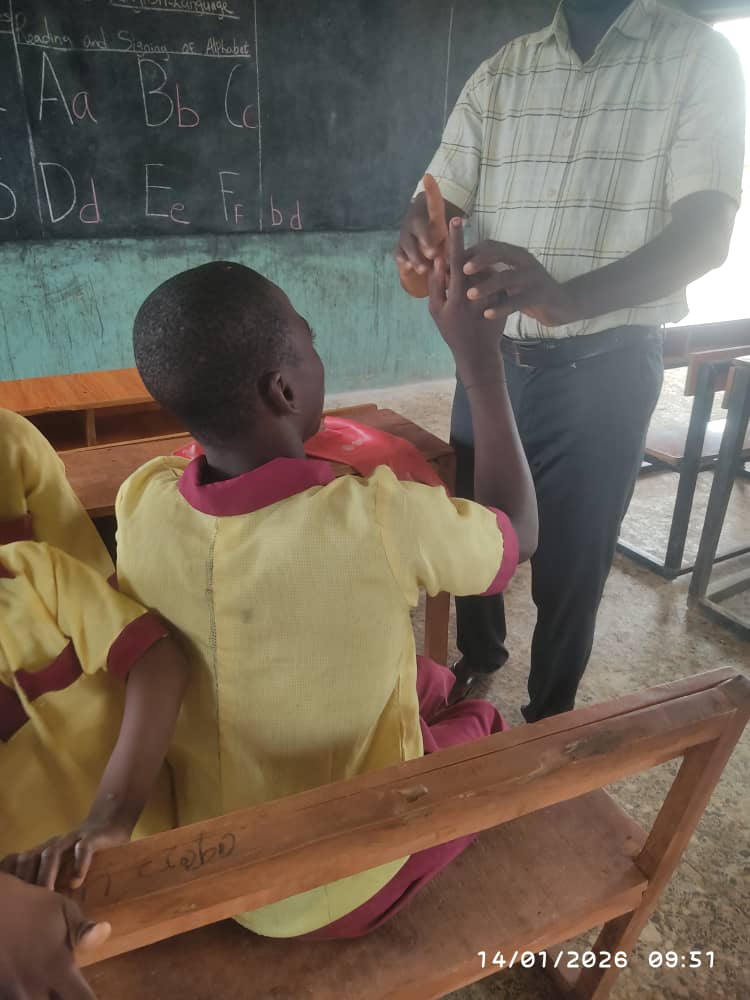
Faced with neglect, abandonment, and disability, children like Ibrahim Muheez and Salam are now learning, playing, and thriving, thanks to a school built by dedicated teachers and a community determined to act. Olodo Special School in Egbada Local Government Area, Ibadan, Oyo State, South-West Nigeria, was born out of necessity. Despite the respite it brings, the school is a shadow of its former self, with dilapidated buildings, a shortage of staff, and a lack of instructional materials for special needs children, among other issues.


When you walk past the unassuming building in Olukunle-Community, Olodo, Egbeda Local Government Area, Ibadan, Oyo State, South West, Nigeria, you would never guess that inside, life is slowly being restored for children with disabilities who have been left behind by society.
There is no signboard, no painted name, only worn walls that hide stories of struggle, survival, and hope.
Among them is nine-year-old Ibrahim Muheez, who at just two years old, measles stole his hearing.
By the age of eight, he was abandoned in a local bakery in Olodo community, Ibadan, Oyo State, South West, Nigeria, struggling alone for food and shelter.
“He was always around the bakery. Dirty, hungry, and alone,” a teacher who helped rescue him recalled. “He could not ask for help. He could not explain where he came from. Some of the market women told us about him during one of our outreach efforts about the existence of the school in one of the markets”.
Ibrahim’s rescue was part of a larger mission.
The Birth of Olodo Special School
Olodo Special School was established in September 2025. The school was born out of necessity. Teachers from Egbeda Special School, in Egbeda Local Government Area of Ibadan, Oyo State, including the headteacher, noticed that families in Olodo Community could not afford to enrol their children in hostels or pay regular feeding fees at the existing facility.
“We saw students coming from Olugonku and Olodo, to Egbeda Special School, miles away from where they stay, but their parents couldn’t afford the hostel fees,” one of the teachers, Sarah Adewumi* explained. “Because of that, some children had to be taken back. We couldn’t leave them like that.”
Determined to reach these children, the teachers mobilized, creating awareness in markets and villages in the community.
“We sang around the markets. We made the awareness. We told parents there is a school for their children with special needs. And to God be the glory, we started in September 2025,” she said.
When the school formally opened, only two out of 14 students had any prior school experience. The rest had never attended a classroom in their lives. Yet, the teachers pressed on, committed to giving these children a chance. “I told my boss that we need somebody to lead the school,” the teacher recalled.
“We need someone present every day, not just coming from Olodo all the time. That’s why we appointed a head for the school. She is very experienced and has already started her work. She has gone to Honourables, the Ministry, local government, they are all aware.”
Ever since its establishment, Olodo Special School has grown to serve over 30 children with varying disabilities, including hearing impairment, physical disabilities, visual impairment, learning difficulties, and cognitive impairment.
Among the students benefiting from the school is AbdulSalam Salawu, a Primary One pupil with multiple disabilities, including hearing and physical impairments. His grandmother, Mutiya Salawu, has cared for him since he was just three months old. “He might be about 19 years old, not 21,” she explains. “Only his mother can truly know his birthday.”
Salam’s life has been marked by struggle from the start. His father died when he was only three months old. He could neither walk nor talk properly, and his grandmother carried him from place to place, seeking help.
“When he was three months old, we didn’t know he could not sit. If we put him down, he would lie himself down,” Mutiya recalls. “I carried him everywhere. People said I should take him to University College Hospital, Ibadan, but the scan cost ₦35,000. We didn’t have it, then.”
Before the school was established, Salam had limited opportunities to socialise or learn. “When they told me to take him to school in Lalupon, I didn’t have the money,” she says. “But when Olodo Special School opened, I was very happy.”
The school has changed Salam’s life. “Now he comes to school by himself, plays, learns, and interacts with other children. It has given him independence I never imagined,” Mutiya says.
22-year-old Ojo Jesutofunmi, in Primary Four with cognitive learning disability, also found a second chance here. Before joining the school, she spent most of her days at home.
“I used to stay at home before,” she said quietly. “I would always sleep at home. But now I am coming to school, and the school is helping me. It is guiding me. It is helping me to know book and to know everything to do at the right time.”
Sitting among her classmates in Primary Four, Jesutofunmi said being in school has changed her life.
“I’m happy,” she said, smiling. “Before, I was just at home. Now I am happy that I’m in school.”
Her dreams are simple but powerful.
“I want to be a teacher,” she said.
“Why?” she was asked.
“Because my parents were teachers. I want to be a teacher.”
At home, life had not been easy. “People at home did not really relate to me well. There was a problem at home,” she explained. “But now that I am learning, they relate to me kindly and friendly.”
Yet, despite the impact, the infrastructure remains fragile.
A solution laced with challenges
These stories are not isolated; they reflect a national crisis. UNICEF estimates that 95 per cent of children with disabilities in developing countries, including Nigeria, are out of school.
In Nigeria alone, an estimated 5 to 7 million children with disabilities are excluded from education, forming a significant portion of the nation’s more than 10.5 million out-of-school children. Against this backdrop, Olodo Special School in Ibadan, Oyo State, is more than a classroom; it is a fragile but vital community-led solution, a place where once-invisible children can learn, grow, and dream.
Yet, the school operates in the shadow of what it ought to be. Its classrooms are old, and learning materials tailored for children with special needs are almost non-existent. Even as it provides a lifeline, Olodo Special School has not yet been officially approved by the government, as it still lacks the infrastructure required for formal recognition.
“The government gave us three classrooms and said the community should support us, but nothing has really changed,” a teacher said on condition of anonymity. “The building is dilapidated. We need help. We need the government and well-meaning Nigerians to come to our aid.”
“The building we are using now needs renovation, and we also need more classrooms to accommodate the growing number of students,” one teacher explained on condition of anonymity.
The school’s needs extend far beyond walls and space. “We need plastic chairs and desks suitable for special children and their teachers, wheelchairs for physically challenged children, a set of drums for school assembly, and special education aids like classroom charts, talking computers, braille slates for blind students, ABC toy radios, and mobility canes,” the teacher added. “We also need a rechargeable public address system for children with cognitive impairment. Without these, it’s very difficult to give our students the quality education they deserve.”
“Some of us teach and also clean the classrooms. We need help. We need the government, and well-meaning Nigerians, to come to our aid.”
Because the building is unsafe, the pupils no longer learn here. Instead, they moved into a borrowed classroom, sharing space not designed for their needs. “The classroom the government gave us has not been renovated, so we are managing with what we can find, another teacher, Segun Abimbola* explained.
While the Oyo State 2025 budget reflects a significant increase in allocation for Persons with Disabilities (PWDs), over 70%, from N492 million in 2024 to N877.5 million, alongside a rise in overheads for the Oyo State Agency for Persons with Disabilities to N345 million, the gaps remain glaring. These funds cover transport, assistive devices, and training, but special schools like Olodo continue to face structural and material shortages.
An inclusive education expert, Dr Adeleke Owoade, highlighted the systemic scale of the problem. “Oyo State has only about 21 or 22 schools for children with disabilities out of more than 2,000 primary schools. That’s less than 1%. UNESCO estimates that at least 10% of the population will have disabilities. The South West is doing better than other regions, but across Nigeria, there is still much to be done in terms of implementation and access,” he said.
Dr Owoade emphasized that the school, though a government initiative, cannot do it alone. Referencing Lagos State’s Public-Private Partnership (PPP) model, he said, “In Lagos, corporate organizations, faith-based groups, NGOs, and individuals collaborate with government to support schools and hospitals. Many schools were adopted, some renovated, and others provided teachers and equipment. Parents, churches, and NGOs can do the same here. Olodo Special School can adopt this model.”
He also stressed the need to adapt programs to children’s abilities. “For children who cannot learn standard academic subjects, vocational training is a practical option. Some can learn tailoring, rabbit rearing, or shoe-making. Those with hearing impairments but no cognitive challenges can continue academics. But for others, engaging in vocational activities gives them dignity and skills for life,” Dr Owoade explained.
He added, “Children should not be sent back home due to age or disability. Coming to school is already a relief for many parents. While children are at school, parents can work or meet other needs. Every child deserves a chance, whether in academics or vocational training.”
Government reacts
The government, for its part, acknowledges the challenges but says progress is underway. In a telephone interview, the Commissioner for Information and Orientation, Prince Dotun Oyelade, said, “You know there are hundreds of schools in Oyo State, and only recently has the government begun reconstruction work. Some of these schools are already nearing completion. What the government did was to prioritize those that needed immediate attention at the donor level. Across the seven zones in the state, a number of schools were selected, and work has started. These things are gradual, but I want to assure you that progress is being made.”
He added, “I understand the situation at that particular school. But we are working in batches, and we are moving as fast as possible.”
This report was produced with support from the Civic Media Lab as part of its Grassroot News reporting Project (GNP) 3.0
Editor’s note: all the names in asterisks are pseudonyms.