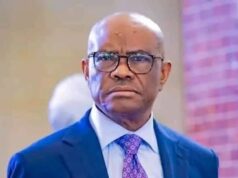








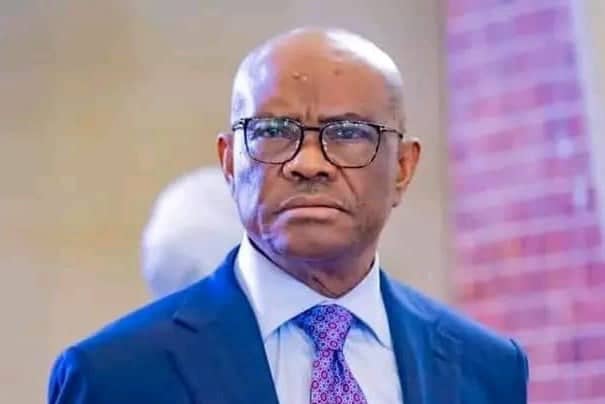


The feud between the governors of the All Progressives Congress (APC) and the Minister of the Federal Capital Territory (FCT), Nyesom Wike, has been brewing for a long time. Although the bubble appeared to burst only last week, Wike and the Progressives Governors’ Forum (PGF) have kept each other at arm’s length for more than a year. What, then, are the issues at stake?
Wike is not a man who lights a candle and hides it under a bushel. When his yam yields fat tubers, he does not bury the harvest deep in the barn. He showcases his work and his support for a president from another party, and that is bound to ruffle feathers in the ruling party.
Should the APC governors be angry with Wike, who took the bullets so that the presidential candidate of his own party, Atiku Abubakar, would lose the 2023 contest? Politics, like light, does not travel in a straight line. Whatever service the former Rivers State governor rendered in helping to bring the APC to power does not entitle him to act as an alternate president in the federal capital, so the PGF thinks.
It is worth recalling that the activities of the Wike-led faction of the Peoples Democratic Party (PDP) in the build-up to the 2023 election so weakened the main opposition party that the APC’s branches were able to sprout more freely across the states. The present bitter fight between the governors and Wike therefore has the flavour of a bittersweet story: difficult to swallow and equally difficult to spit out. The elders say one does not receive a double portion and then complain. That proverb, however, is not sitting well with the APC governors at present, as far as the Wike matter is concerned.
Nyesom Wike led the G5 governors within the PDP who thoroughly discomfited their party on the road to the 2023 presidential election. They held dancing marches across their states and, in a curious piece of self-branding, called themselves “monkeys,” with Wike as the “chief monkey.” Atiku Abubakar, the PDP’s presidential candidate, was the principal victim of the negative campaigns they orchestrated. They pressured him to reverse decisions for which he was not primarily responsible, simply to create an impossible situation. He was, for instance, demanded to remove Iyorchia Ayu as national chairman—even though members of the same G5 had nominated Ayu and were better placed to convene a National Executive Committee (NEC) meeting to force his resignation. Whether Atiku’s political antennae failed him or he simply chose to ignore the G5’s ‘noise’, the result was that the G5 members were allowed to eat their cake and have it. At the time, members of the PGF smiled heartily as the camp of their main opponent crumbled. Wike must have appeared a useful ally who had demonstrated loyalty to the progressive cause.
Reports after the election of President Bola Ahmed Tinubu suggested that some APC governors would have preferred Wike’s wings to be clipped at the start of the new administration in May 2023. The President, however, chose to reward a loyalist as he saw fit. The former Rivers governor was given the FCT—described by one observer as a “make-me-shine” appointment, especially for a man who knows how to exploit the inherent power of the office. The FCT is littered with abandoned and uncompleted projects dating back to the Second Republic. The Jonathan administration initiated several schemes between 2010 and 2015 that the Buhari government failed to complete in eight years. Any serious politician seeking to advertise his capacity would simply latch onto those projects and begin finishing them one after another. That is precisely what Wike is doing, thereby giving the Tinubu government the image of a working administration in the eyes of FCT residents.
Few APC governors or chieftains object to that achievement. What they resent is Wike’s public style, which projects the impression of two presidents in the capital. They dislike the flags on his official vehicles—he is, after all, a representative of the President. They are particularly angered by the launch of his “Rainbow Coalition,” which signals a handshake between elements of the PDP and the APC. Some sources insist that the irritation runs deeper than the immediate run-up to the 2027 elections and is linked to calculations for 2031. A rational observer might regard that as a distant target, but politicians are forever thinking ahead.
The grumbling began quietly. Aggrieved voices carried complaints to President Tinubu about Wike’s alleged excesses and the need to cut his tail. They pointed to publications that portrayed his actions as infractions and highlighted his perceived abrasiveness towards APC officials. The dispute moved into the open when Wike’s feud with Rivers State Governor Siminalayi Fubara reached fever pitch. Wike had a public altercation with the APC’s national secretary, Senator Ajibola Bashiru, and a cold war developed with the chairman of the PGF, Senator Hope Uzodinma.
It is understood that the Imo State governor escorted Fubara to a discreet meeting at the presidential villa—an intervention that appeared to stabilise the Rivers governor for some months. The PGF also sought to rally behind Fubara, presenting him as a regular party governor who should automatically assume leadership of the APC in the state and emerge as its gubernatorial candidate in 2027. To say that Wike was riled by this push would be an understatement. The subsequent spread of the Rainbow Coalition beyond Rivers State can be traced directly to that episode. As P-Square once sang, “Do me I do you, man no dey vex”—and that seems to have been the soundtrack for Wike and his allies as they launched the coalition in key states.
The squirrel that once seemed safely caged in the net of the APC governors has escaped and is now high up the palm tree, preparing to crack the ripe fruits. The fight-back from the PGF is therefore entirely understandable.
The entire drama, however, speaks volumes about the character of Fourth Republic democracy so far. We are supposed to be practising one-man-one-vote in a multi-party system, yet politicians—and certain provisions of the Electoral Act 2026—have sought to constrict the space and block the pathways through which the people might exercise real choice. We have grown accustomed to the reality that once a governor emerges, he immediately becomes the leader of his party, ranking above those who guided him through the campaigns and showed him the vote banks. For his second term, he effectively chooses himself, selects the members of the House of Assembly, the House of Representatives, and the Senate, and directs his party men on which presidential candidate to support.
The 2026 Electoral Act (as amended) attempted to enhance the governor’s power still further by requiring political parties to submit digital copies of their membership registers before primaries. The intention was that once a politician’s name was locked in the Independent National Electoral Commission’s database, defection after the primaries would become far more difficult. The plan, in effect, was to cover the shenanigans perfected during party primaries and force defeated aspirants to remain in their parties, willy-nilly. A friend had remarked that the lawmakers might have slept off when the provision was passed, because they would be the major victims. But when I asked a senator, he said there would always be a way out. “As politicians, we will always find a way out,” he said.
Wike’s Rainbow Coalition is now providing the pathway, and by that, the PGF believes that it is upsetting the apple cart in Kwara, Imo, Cross River and other states. The governors’ forum is not amused. Wike insists that President Tinubu is the intended beneficiary. PGF members, however, know that the coalition could rescue politicians they had written off and threaten their own hold on the states. Some of the actors are indeed speaking with an eye on 2031. The calculation is that if Wike succeeds in drawing APC members into the PDP fold, the arrangement could serve as a launchpad for his own ambition in eight years.
Politicians like to abridge time, but only God can command time, that ultimate conqueror of man, his authority and power. Last year, we started hearing of 2027 as if the new year 2026 had been erased off the calendar. But as God would have it, the year 2026 is running its course. 2027 will come and go; only God knows what the intervening years will deposit on the surface of the earth, and only the Almighty will determine whose feet will continue to thump the surface when the curtain opens on 2031. Nonetheless, politicians remain incurably ambitious.