














By Bode Akinbode
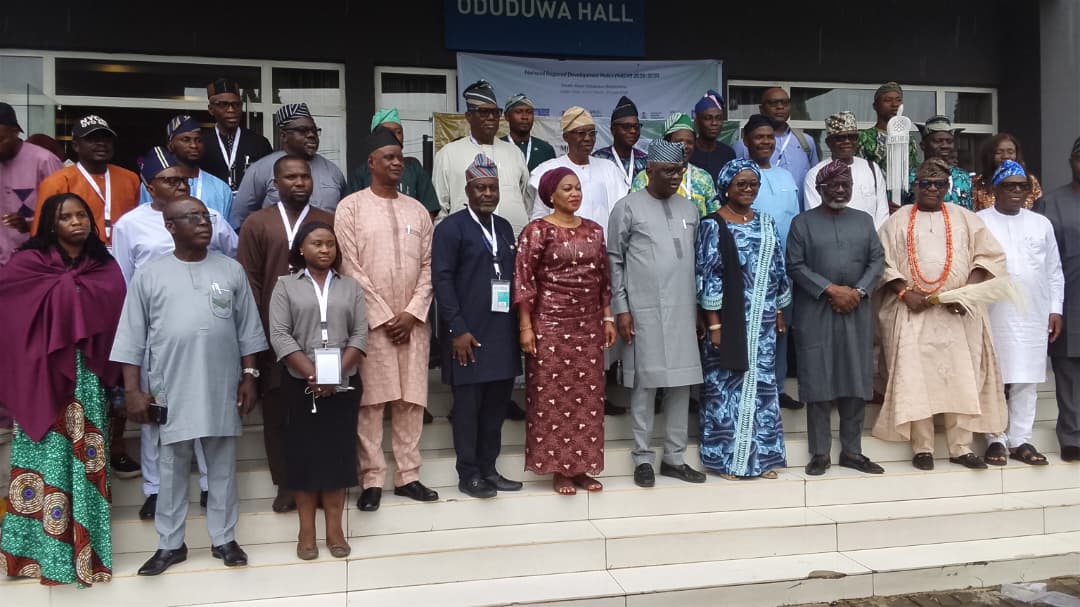
The Federal Ministry of Regionlal Development, in partnership with the United Nations Development Programme, on Wednesday held the South-West Technical Validation Workshop on the National Regional Development Policy 2026–2030 in Ibadan


The workshop, held the Golden Tulip Hotel, Ibadan forms part of a nationwide series of zonal consultations across Nigeria’s six geopolitical zones aimed at validating and refining a comprehensive framework for regional development before its submission to the Federal Executive Council for approval.
The proposed National Regional Development Policy is designed to provide a coordinated national framework for addressing structural disparities in infrastructure, investment distribution, economic opportunities and service delivery across Nigeria’s regions.
The policy is anchored on the Medium-Term National Development Plan 2026–2030 and aligns with the development priorities of the administration of President Bola Ahmed Tinubu.
While declaring the one-day we workshop open, the Honorable Minister for Regional Development, Engr. Abubakar Momoh said the policy seeks to transform Nigeria’s six geopolitical zones into engines of inclusive growth through place-based development strategies capable of improving territorial balance and strengthening national competitiveness.
Represented by the Permanent Secretary, Ministry of Regional Development, Dr Mary Ada Ogbe stated that persistent inequalities in infrastructure, economic concentration and access to opportunities have constrained national productivity and social stability.
He explained that the NRDP provides guiding principles, strategic pillars, financing mechanisms, governance structures and accountability systems aimed at coordinating development efforts across all levels of government.
“The framework identifies key structural challenges confronting the country, including over-concentration of investment in urban centres, weak production systems, fragmented value chains, poor intergovernmental coordination, infrastructure deficits, insecurity and climate-related risks such as flooding, erosion and desertification”. he said
Speaking on behalf of the Resident Representative of the United Nations Development Programme in Nigeria, Ms. Elsie Attafuah, Mr. Matthew Alao described the engagement as a critical step towards redefining Nigeria’s development trajectory.
“This event holding here today is critical to redefining Nigeria’s development trajectory. It represents a moment that calls not simply for regional development but for a deliberate recalibration of how development is planned, coordinated, financed and delivered across Nigeria,” he said.
Alao noted that the National Regional Development Policy being jointly developed by stakeholders is intended to serve as a practical development tool capable of translating Nigeria’s aspirations into measurable economic transformation with direct impact on citizens.
He also highlighted the historical significance of regional governance in Nigeria, referencing the developmental strides recorded during the First Republic, particularly in the old Western Region, including educational advancement and the establishment of Nigeria’s first television station in Ibadan.
According to him, regional development presents an opportunity to reposition Nigeria’s regions as centres of innovation, industrialisation, productivity, resilience and inclusive prosperity.
“While successive national development plans have recorded progress, the gains remain unequally distributed across regions,” he said, citing disparities reflected in the country’s multidimensional poverty index.”, Alao said
He explained that the establishment of regional development commissions by the Federal Government is aimed at ensuring balanced, equitable and transformative development across the country.
“The Regional Development Commissions are strategically positioned to drive infrastructure, investment, coordinated economic transformation and integration across the six geopolitical zones,” he added.
Also speaking, Chairman of the South-West Development Commission, Senator Olubunmi Adetunmbi, stressed the need for proper constitutional alignment between the proposed policy framework and the powers of state governments.
He emphasised the importance of establishing a clear legal framework for intergovernmental collaboration, budgetary oversight, security coordination and institutional cooperation between federal and state authorities.
Adetunmbi noted that effective implementation of the policy would depend largely on a unified framework capable of harmonising development priorities across different tiers of government.
In his remarks, the Olubadan of Ibadanland, Oba Rashidi Ladoja, represented by Osi Olubadan, Oba Abiodun Koladaisi, called for practical strategies on implementation, resource mobilisation and coordination among stakeholders.
Oba Ladoja urged participants to leverage the South-West’s strong private-sector ecosystem to attract domestic and international investments for regional development.
He said recommendations from the workshop would help to shape the final policy document and contribute to the development of a balanced, prosperous and competitive region.
Participants across government, private sector and civil society, during the technical session, made several recommendations and demands to strengthen the draft policy which includes the urgent upscale of regional security networks to combat the rising spate of kidnappings, banditry and attacks on communities.
“No infrastructure or economic plan can succeed without safety of lives and property. Security must be prioritised before investment and infrastructure plans,” a participant from Ogun State said.
Other recommendations are; increased private-public partnership funding in addition to Federal Government funding for projects critical to the region’s development, demand for a constitutional framework that will allow regions to develop at their own pace within the federation and the alignment of the Federal Government’s regional development plan with the South-West’s development priorities among others
They called for stronger collaboration with Development Agenda for Western Nigeria (DAWN) Commission in both policy formulation and implementation for the region.