
















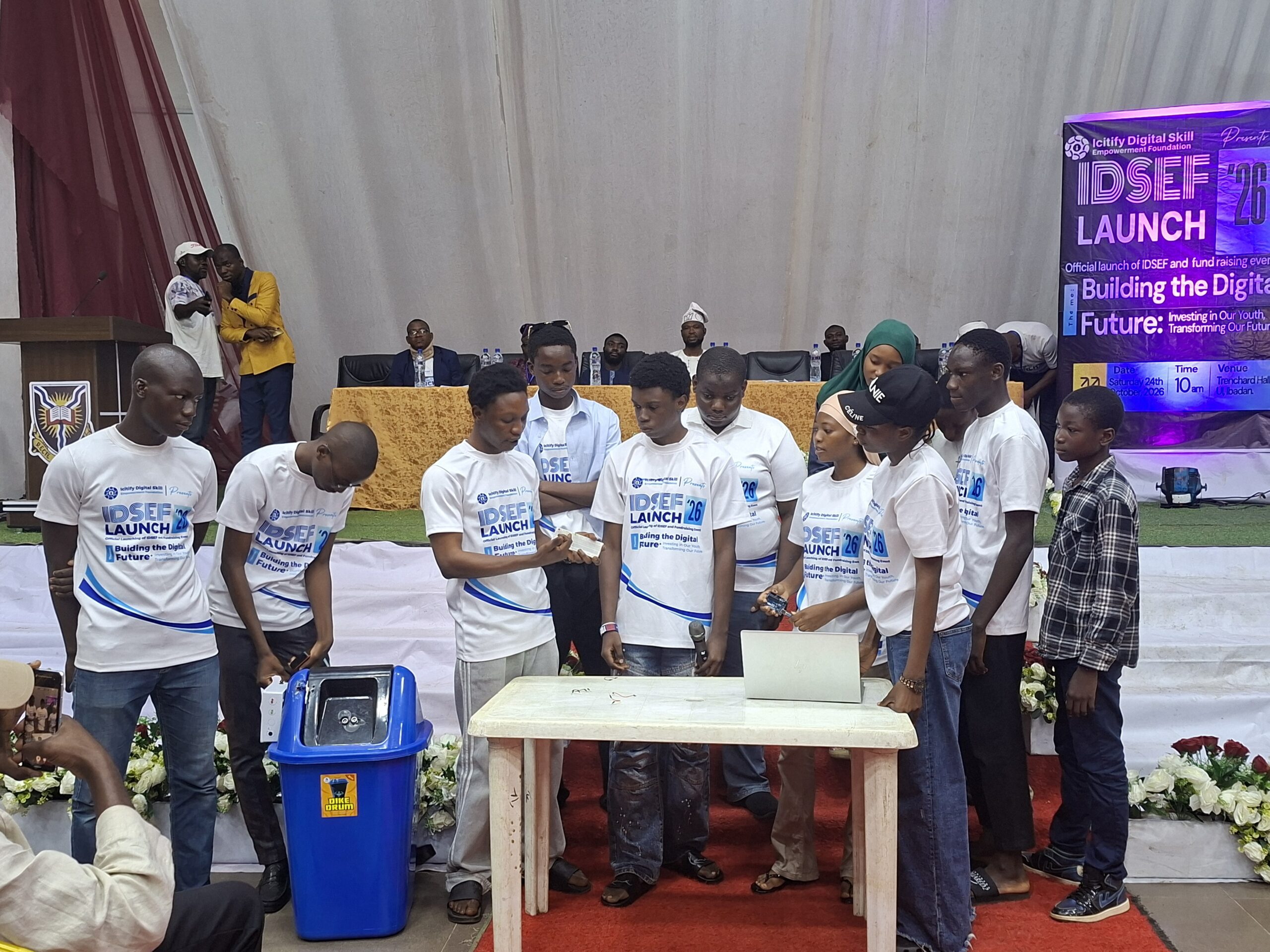
The Icitify Digital Skills Empowerment Foundation (IDSEF) has been launched in Ibadan, Oyo State, with a call for public and private sector support to equip Nigerian youths with digital skills for employment, entrepreneurship and participation in the global digital economy.
The foundation was unveiled at a launch and fundraising ceremony held at Trenchard Hall, University of Ibadan, on Saturday, October 24, 2026.


The event, themed “Building Digital Futures: Investing in Our Youth, Transforming Our Future,” brought together academics, political leaders, industry players, students and development partners.
Delivering the keynote address, the Vice-Chancellor of Summit University, Offa, Kwara State, Professor Abiodun Musa Aibinu, said equipping young Nigerians with digital capabilities was fundamental to building the country’s next-generation economy.
He urged the Federal Government to introduce Artificial Intelligence (AI) and digital literacy into secondary and tertiary education curricula to develop young people’s digital confidence and problem-solving skills.
Aibinu noted that AI, Data Analytics and Cybersecurity were already transforming workplaces and economic activities, urging youths to embrace technology, seek mentorship and take advantage of available learning opportunities.
“The future will not be built by technology alone; it will be built by people who have the skills, imagination and opportunity to use technology well,” he said.
He added that Nigerians must not remain spectators in the digital revolution but should acquire the skills needed to participate actively in shaping it.
The founder and Chief Executive Officer of IDSEF, Mr AbdulAzeez Adelopo, said the foundation was established to widen young people’s access to digital skills and development opportunities required to thrive in the changing global economy.
He listed the foundation’s areas of focus as Software Engineering, Cybersecurity, Data Analytics, Cloud Computing, User Interface/User Experience (UI/UX) Design, AI and Machine Learning, Data Science, Digital Marketing, Robotics and Drone Technology, leadership and entrepreneurial skills.
Adelopo explained that the foundation’s programmes would operate around five pillars: Access, Learn, Build, Connect and Progress.
According to him, the model would provide young people with practical training, opportunities to apply their knowledge through real-world projects, mentorship and industry connections to improve their prospects for employment and entrepreneurship.
He called on individuals, businesses, government agencies and development partners to support the foundation’s fundraising drive to provide the infrastructure, equipment, personnel and learning resources required to establish and operate its programmes.
Adelopo said prospective supporters could sponsor individual learners or cohorts, donate information and communications technology (ICT) and robotics equipment, support school-based programmes, provide mentorship and technical expertise, or become strategic partners.
The chairman of the foundation’s board, Dr Taofeek Akinola, said the launch represented the formalisation of nearly two decades of community service by Adelopo, who had voluntarily equipped people, including members of his family, with digital skills.
“What therefore began as a small act of kindness and selfless service to fellow men is becoming a platform for national impact,” he said.
Akinola noted that Nigeria’s estimated 110 million children and adolescents represented a significant demographic advantage that could be converted into productive human capital through skills development.
He urged federal, state and local governments to sponsor digital and vocational skills training on a large scale.
He also called on private sector organisations, including banks, fast-moving consumer goods companies, telecommunications firms and oil and gas companies, to make structured skills development a priority under their corporate social responsibility programmes.
In their goodwill messages, the African Action Congress governorship candidate in Oyo State, Chief Saheed Oladele, and a former All Progressives Congress governorship aspirant, Engineer Oyedele Hakeem Alao, stressed the importance of information technology to national development.
Oladele said ICT hubs could help address youth unemployment and insecurity, urging young Nigerians to acquire relevant digital skills.
“We cannot afford to be analogue in a digital age. The earlier you get ICT knowledge, the better,” he said.
Alao warned that countries that failed to develop their information technology capabilities risked being left behind, calling for IT education to become compulsory from primary school.
He cited the early exposure to technology enjoyed by his children studying in Oman, saying digital skills were increasingly important as AI continued to reshape the global economy.
“My children who study in Oman started learning IT skills from Primary 2. We need to encourage our kids. IT skill is as important as anything if we are going to match up with AI prospects today,” he said.