














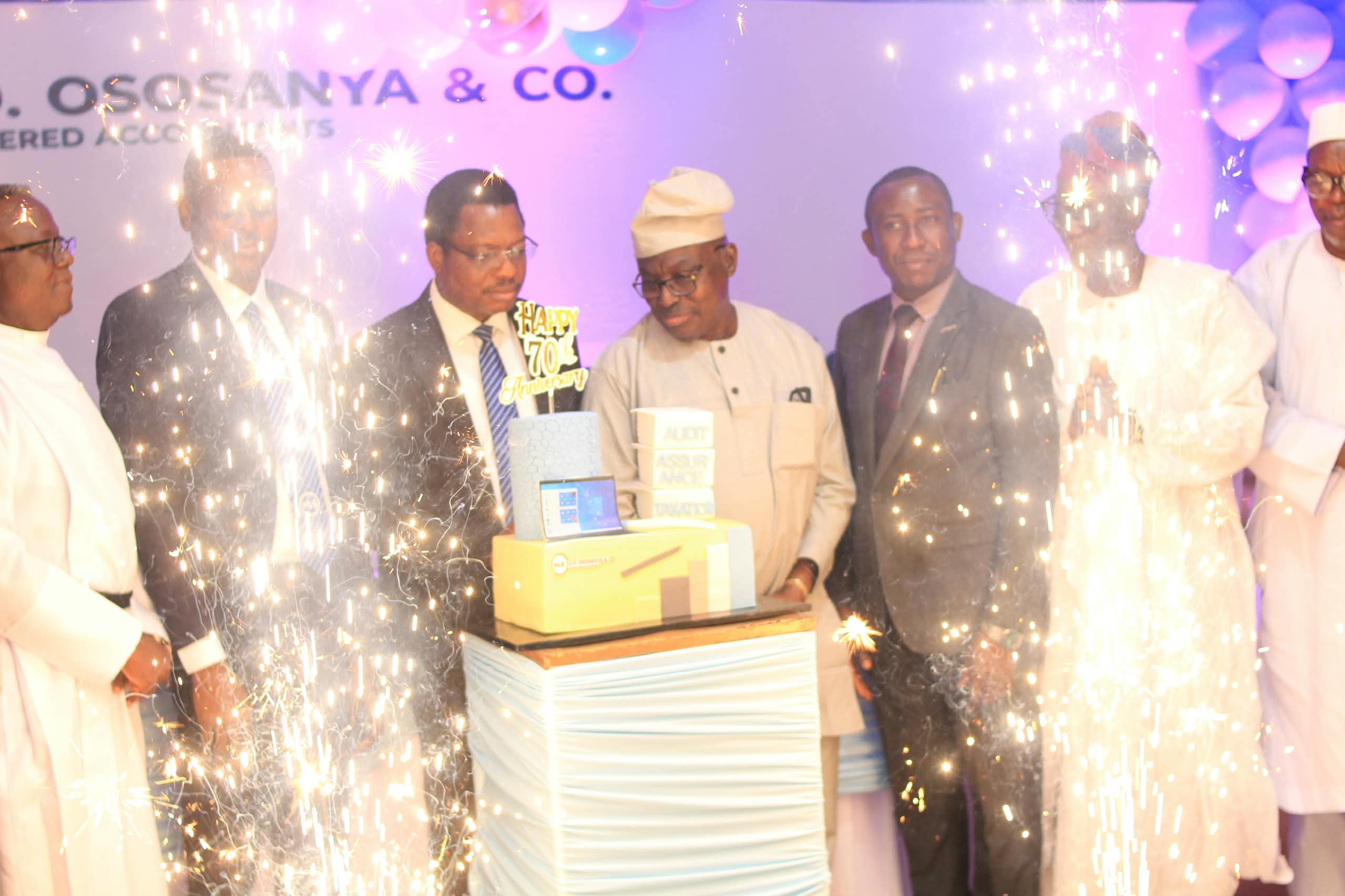
For seven decades, the story of HLB Z. O. Ososanya & Co. has been one of professional endurance, institutional growth, adaptation and service.
Established in Ibadan on September 17, 1956, the firm has grown from its beginnings in the ancient city into a professional institution with offices in Lagos and Abuja and an international affiliation through HLB International, a global network of independent accounting and business advisory firms.

Its 70th anniversary celebration was therefore more than a commemoration of longevity. It was an opportunity to look back at the foundations upon which the firm was built, examine the forces that have sustained it across generations and consider how it can remain relevant in an accountancy profession being transformed by digitalisation and artificial intelligence.
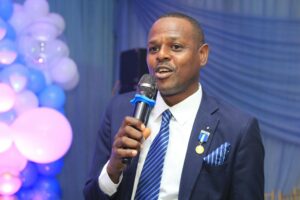
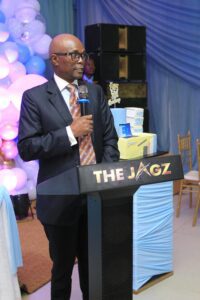
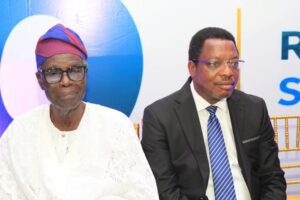
The anniversary, held at The JAGZ Hotels, Ibadan, brought together accounting professionals, academics, lawyers, business leaders, clients, former employees, friends and associates of the firm.
The gathering also provided an opportunity to celebrate the memory of the late Dr Zacchaeus Oludayo Ososanya, FCA, whose professional journey was closely linked with the development of accountancy in Nigeria and the emergence of the institution that later became the Institute of Chartered Accountants of Nigeria (ICAN).
The President and Chairman of the Council of ICAN, Hajia Queensley Sofuratu Seghosime, represented by a member of the institute’s Governing Council, Mrs. Olaitan Babatunde,recalled the founder’s contribution to the profession.

She said Ososanya was a foundation member of the body that preceded ICAN and subsequently served on the institute’s Council for more than 13 years. He also served as president during the 1968/1969 presidential year.
That history placed the firm’s anniversary within the broader story of the development of professional accountancy in Nigeria.
For Seghosime, however, preserving such a legacy requires more than looking backwards. She said the changing nature of the profession required accounting firms to respond to new technologies and regulatory expectations while retaining the principles that had historically earned the profession public confidence.
“At a time when new regulatory expectations are reshaping the accountancy profession, the continued relevance of any firm will depend on its readiness to innovate without compromising professional ethics,” she said.
She urged established firms to invest in their people and prepare younger professionals for leadership.
“Your task is not simply to preserve what was built; it is to build upon it. You must continue to invest in your people, uphold the highest standards of professional conduct, embrace innovation, and prepare younger professionals to lead with competence and character,” she said.
That message captured one of the central themes of the anniversary: the relationship between legacy and renewal.
An institution that has survived for 70 years must necessarily change with its environment. Yet, according to the speakers at the celebration, such change must not come at the expense of the values that made the institution endure.
The firm’s journey began in Ibadan in 1956, at a time when Nigeria was approaching independence and its professional and commercial institutions were still developing.
Seven decades later, Ososanya & Co. has expanded its presence beyond its original base, with offices in Lagos and Abuja, while its affiliation with HLB International has connected it to a wider global professional network.
For Ambassador [Dr] Olatokunbo Awolowo-Dosumu, the Mother of the Day, the expansion reflected the strength of the foundation laid by the founder.
Awolowo-Dosumu, Chairman of ANN Plc, described the firm’s seven-decade journey as evidence of the importance of professionalism, integrity, trust and enduring relationships in building institutions that can survive across generations.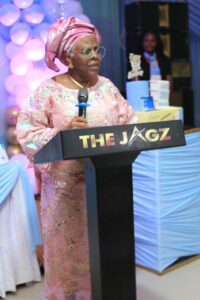 Awolowo-Dosumu
She also recalled the relationship between her parents, Chief Obafemi Awolowo and Yeye Oodua Hannah I.D. Awolowo, and the founder of the firm.
According to her, the relationship developed beyond a conventional auditor-client arrangement into one based on trust, friendship and family ties. She said businesses established by her parents continued to engage the firm’s services, reflecting the confidence that had developed over the years.
For her, the lesson from the firm’s journey was that growth must remain anchored in the values upon which the institution was established.
“May the values upon which it was founded remain strong, even as it embraces new generations, new technologies and new opportunities,” she said.
Her remarks were especially relevant at a time when professional service firms are facing rapid changes in technology, client expectations and competition.
Perhaps nowhere is the transformation of Ososanya & Co. more visible than in its adoption of technology.
The Managing Partner, Babatunde Kolawole, FCA, said the firm had moved significantly from the manual processes that characterised its earlier years.
Traditional audit, taxation, secretarial and consulting processes have increasingly given way to digital platforms, cloud-based systems and virtual collaboration.
Kolawole explained that audits could now be conducted digitally, in some cases without physical visits to clients.
Virtual meetings, broader transaction testing and cloud-based file management have also become part of the firm’s operations.
In taxation, the firm has adopted online portals, TaxPro-Max and Revolution 360 to improve efficiency and facilitate service delivery.
The changes illustrate how dramatically the accountancy profession has evolved since the firm was established.
In the early years, accountants relied heavily on physical documents, manual calculations and face-to-face interactions. Today, large volumes of financial information can be accessed, analysed and transmitted electronically, while clients can engage professional advisers remotely.
Kolawole said AI was increasingly being deployed globally for tasks requiring human intelligence in auditing and management consultancy.
But while technology may perform increasingly sophisticated functions, he stressed the continuing importance of professional judgment.
The future of accountancy may involve more automation, but the profession will still require professionals capable of interpreting information, challenging assumptions, understanding context and making ethical judgments.
For a firm celebrating 70 years, therefore, innovation is not simply about purchasing new software. It is about adapting the institution’s knowledge, people and processes to a fundamentally changing professional environment.
The anniversary also demonstrated that the firm’s story is not entirely about financial statements, audits, taxation and advisory services.
ICAN’s call for firms to invest in younger professionals reflected the importance of succession to institutional survival.
A 70-year-old firm cannot depend indefinitely on the generation that founded or built it. Its future depends on whether it can transfer professional knowledge, institutional culture and ethical standards to those coming behind.
This makes human capital development as important as technological investment.
The challenge is significant in an environment where younger professionals are entering a workplace transformed by artificial intelligence, data analytics and digital platforms.
They need technical competence, but they also require professional judgment and ethical grounding to use technology responsibly.
That was why the ICAN president’s message combined innovation with integrity. The two, in her view, should not be treated as competing priorities.
The anniversary also became a platform for discussing Nigeria’s economic future. The Vice-Chancellor of Lead City University, Prof. Kabiru Aderemi Adeyemo, represented by Oluwatosin Adesina, FCA, used the occasion to examine the country’s economic reforms and their implications for businesses and households.
Speaking on “Reviving the Economy, Sustaining the Reforms: Pathways to Inclusive Growth, Institutional Renewal and National Prosperity,” Adeyemo warned against what he described as “erosion by convenience.”
“The single greatest threat to Nigeria’s reforms is not a decree of reversal, it is erosion by convenience,” he said.
He cited the return of subsidies under different names, exchange-rate concessions to favoured sectors, waivers of revenue rules and pressure on monetary authorities to finance shortfalls as examples of practices that could weaken reforms.
Adeyemo argued that economic reforms should ultimately be judged by their ability to improve the lives of Nigerians. He called for greater attention to job creation, household incomes, social protection, agriculture, manufacturing, electricity, infrastructure, SMEs and human capital development. He also advocated a National Economic Reform Compact with measurable targets, independent monitoring and annual public assessments to ensure continuity in economic policy.
The relevance of the message to the accountancy profession is evident.
Accountants occupy an important position in the architecture of financial accountability. Through auditing, reporting, taxation, financial controls and advisory services, they help organisations and institutions understand and account for the resources entrusted to them.
The profession therefore has responsibilities beyond the preparation of financial statements.
Credible financial reporting and transparent accounting systems are important to investors, businesses, governments and the wider public.
Adeyemo also urged accountants to strengthen public accountability through credible financial reporting, transparent procurement, effective auditing and ethical professional practice.
That responsibility becomes even more important when economic conditions are difficult and public resources are under pressure.
For businesses, professional accountants can provide information needed to make investment and operational decisions.
For government and public institutions, effective financial controls can help strengthen accountability.
For society, confidence in financial information can influence perceptions of the integrity of institutions and markets.
The anniversary thus placed the firm’s professional journey within a larger national context.
The question is no longer simply whether an accounting firm can survive for 70 years. It is also what contribution such an institution can make to the economy and society around it.
Giving Back to Society
The firm’s 70th anniversary programme also included a social intervention at orphanage homes, including Total Parental Guidance Orphanage in Oluyole, Ibadan.
The firm donated food items, cash, school bags and other consumables to the home as part of activities marking the anniversary.
The Head of Finance and Administration, Mr Olufemi Otunla, who presented the items, lauded the management of the orphanage for its work with the children.
“They are doing fantastic work. They are putting children on the right path. God will make the children great,” he said.
A partner in the firm, Mr Simon Awotoye, also commended the home for its efforts in caring for the children.
Kolawole said the visit was an opportunity for the firm, as it marked 70 years, to identify with people committed to improving the lives of vulnerable children.
Responding, the School Administrator of the orphanage, Pastor Mrs Grace Akpan, appreciated the gesture and highlighted the progress recorded by some of the children.
She said the first child admitted into the home had graduated from university and was working in a bank, while others were studying in universities and learning vocational skills.
The intervention added another dimension to the anniversary: the idea that institutional success should be accompanied by social responsibility.
The celebration also featured a documentary chronicling the formation and evolution of HLB Z. O. Ososanya & Co. The documentary highlighted the firm’s milestones, professional strides, innovation and transformation over the decades.
Former staff members and prominent Nigerians also shared reflections on the firm and its founder.
A posthumous award was presented to the late founder, with Mr Olufemi Ososanya, a former Managing Partner, receiving the honour on his behalf. The award served as a symbolic link between the institution’s past and present.
Seven decades after Ososanya established the firm, the name he gave to the practice continues to exist within a professional environment radically different from the one he encountered in 1956.
Yet the principles repeatedly referenced during the anniversary – trust, integrity, professionalism and excellence – remain central to the firm’s identity.
The Chairman of the occasion and Group Managing Director of Odu’a Investment Company Limited, Abdulrahman Yinusa, represented by the Executive Director, Finance, Mr Biodun Bamiduro, described the firm as an institution built on integrity, professionalism and excellence.
He said its next 70 years should provide opportunities for greater growth and impact.
That also will inevitably be shaped by developments that could not have been imagined when the firm began.
Artificial intelligence, automation, digital taxation, remote auditing, data analytics and changing regulatory requirements are already altering the way professional services are delivered.
At the same time, clients increasingly expect speed, efficiency, specialist knowledge and technology-enabled solutions. Still, the fundamental expectations of the profession remain familiar.
Businesses need reliable financial information. Investors require credible reporting. Governments need accountability. And society expects professionals entrusted with financial information to act with integrity.
That is perhaps the central lesson of Ososanya & Co.’s 70-year journey.
Technology may change the tools of accountancy, but it does not remove the need for trust. Digital platforms may transform the process of auditing, but they do not eliminate the need for professional judgment. Artificial intelligence may automate some tasks, but it cannot by itself provide the ethical responsibility expected of a professional.
And expansion may create new opportunities, but institutional growth must remain connected to the values that gave the organisation its identity.
From its beginning in Ibadan in 1956 to its presence in other Nigerian cities and its international affiliation, HLB Z. O. Ososanya & Co.’s journey mirrors, in many respects, the evolution of Nigeria’s professional services sector.
Its 70th anniversary was therefore not simply a celebration of age. It was a reflection on what allows institutions to endure – strong foundations, continuous renewal, investment in people, responsiveness to change and a commitment to values that outlive individual generations.
As the firm looks beyond its first 70 years, the challenge is to preserve the trust associated with its name while finding new ways to serve clients, develop professionals and contribute to the economy.
For an institution that began in Ibadan seven decades ago, the journey from local practice to an internationally connected professional firm represents a considerable transformation.
The next chapter will be defined by how successfully it combines the lessons of its past with the possibilities of the future.
After 70 years, the Ososanya story is a story of continuity through change – a legacy built on trust, strengthened by professionalism, tested by time and now being carried into a digital world.