















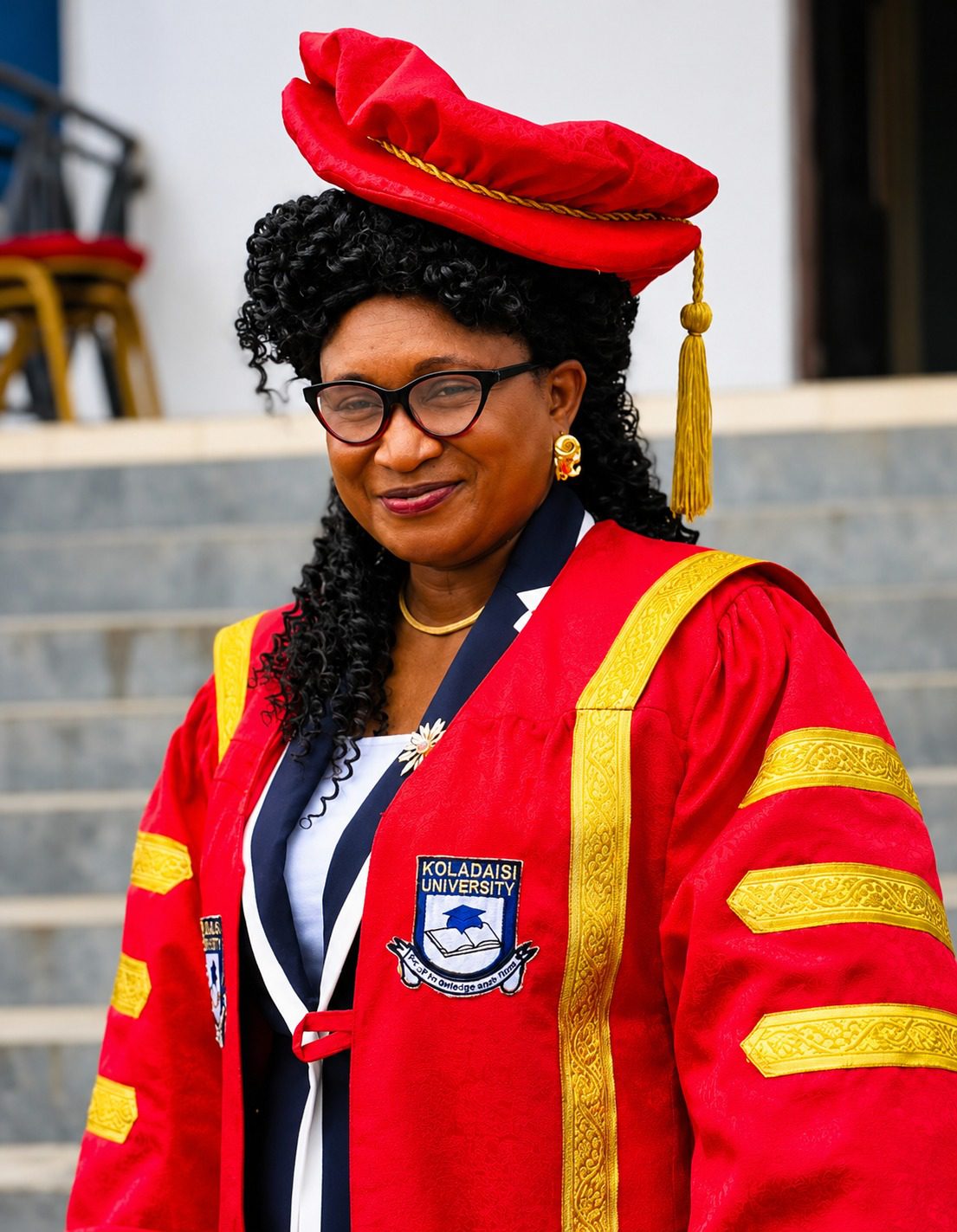
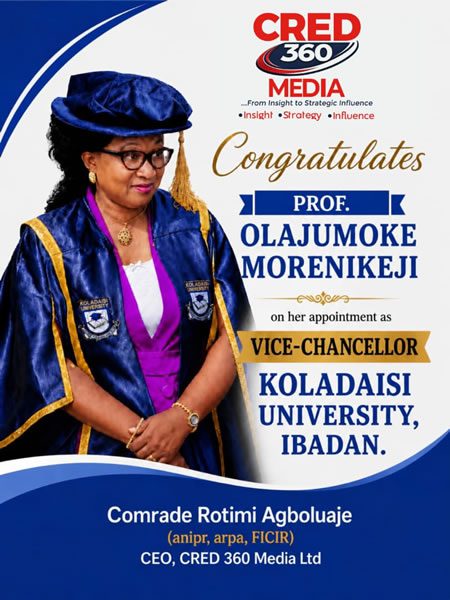
Professor Olajumoke Morenikeji is the Vice-Chancellor of KolaDaisi University (KDU), Ibadan. In this interview, the professor speaks about her emergence as the university’s first female Vice-Chancellor, opportunities for women, her leadership priorities, research, entrepreneurship, the challenges confronting private universities, funding of education and her vision for KDU over the next five years.

How did you receive your appointment as the first female Vice-Chancellor of KolaDaisi University?
I received the appointment with profound gratitude to God. More importantly, I see it as a responsibility and an opportunity to make a meaningful impact – not only on KolaDaisi University, but also on the younger generation.
I have always believed that leadership is ultimately about service. I therefore see this appointment as an opportunity to serve the university and contribute to the realisation of the vision of our Founder, Chief Kola Daisi, CON.
Our Founder is deeply committed to education and to the development of young people. I have seen first-hand, over the years, his dedication to sustaining the university, providing a conducive environment for learning, and ensuring that our students receive quality education. That commitment is a major source of encouragement to me.
I am equally encouraged by the support of the Board of Trustees and the Governing Council. With their support, I am confident that we can further strengthen KolaDaisi University, deepen its impact, and build an institution of which our students, staff, alumni and the wider community can be proud.
Your appointment has historical significance as KolaDaisi University’s first female Vice-Chancellor. What does this milestone mean to you, and what message does it send to young women?
The most important message is that women should place no self-imposed limits on what they can achieve. With vision, preparation, hard work, perseverance and integrity, women can aspire to and succeed in positions of leadership and professional excellence.
To be honest, I was initially surprised when people began referring to me as the university’s first female Vice-Chancellor. I was never driven by that distinction. My focus has always been on doing my work to the best of my ability, accepting responsibility whenever it is entrusted to me, and striving to serve with integrity, accountability and excellence.
For me, the lesson for young women is that achievement should not be defined by gender. It is shaped by preparation, hard work, resilience, discipline, integrity and the courage to pursue one’s aspirations.
Women should not spend their lives asking whether something is possible for them simply because they are women. They should prepare themselves, acquire the necessary competence, do the work, and have the courage to pursue the opportunities before them.
If my appointment encourages even one young woman to believe that she can aspire to the highest level of her profession and pursue that aspiration with confidence, then I consider that an important part of its significance. Ultimately, I believe that, with God, there are no limits to what we can achieve.
From your experience, do Nigerian women today have sufficient opportunities to pursue education, careers and leadership positions?
I believe opportunities have expanded considerably for women in Nigeria. The landscape today is very different from what existed in the past. Women are increasingly accessing higher education, entering professions that were once largely male-dominated and occupying leadership positions across different sectors.
At KolaDaisi University, we are committed to maintaining an environment in which both men and women can develop and excel.
However, opportunity alone is not enough; what you do with it is what truly matters. Women must be intentional about their education, their careers and the goals they set for themselves. They must remain focused and refuse to be distracted from their purpose.
I would therefore encourage young women not to define themselves by limitations. They should acquire the competence they need, set clear goals, work hard and position themselves for leadership.
What advice would you give young women aspiring to leadership and professional excellence?
First, believe in yourself and in your ability to achieve your goals. Then prepare yourself diligently, because lasting success is built not only on confidence, but also on competence, character and hard work.
Young women must understand that excellence does not happen by accident. It requires discipline, hard work, continuous learning and perseverance. They must also protect their integrity. No position or achievement is worth compromising your values.
They should not lower their standards simply because they are women or because they are trying to get ahead. They should build competence, remain focused and allow the quality of their work to speak for them.
Above all, they should trust God and remain committed to their goals. The journey may not always be easy, but difficulty should not be mistaken for impossibility.
What would you describe as KolaDaisi University’s major strengths as it competes in Nigeria’s higher education sector?
One of our greatest strengths is our commitment to providing an enabling environment for teaching, learning and research. We are also privileged to have a founder whose unwavering commitment to the university’s growth is reflected in his strong support for academic excellence, research, innovation and staff development.
Another significant strength is our Board and Governing Council, comprising accomplished professionals and distinguished leaders who are deeply committed to the university’s long-term growth, good governance and sustainability. Their strategic guidance and wealth of experience provide a strong foundation for the continued advancement of KolaDaisi University.
Our location in Ibadan is also strategic. Ibadan has a rich educational heritage and provides an environment in which a university such as KolaDaisi can thrive.
But beyond infrastructure and location, the greatest potential lies in our people. We are building the right calibre of staff, attracting students with the potential to excel and developing an institutional culture that values excellence. Our ambition is not simply to grow in size. We want to grow in quality, reputation, research strength and impact.
What are the major challenges confronting the university, and how are you addressing them?
Funding is one of the major challenges confronting universities generally, and private universities are no exception. A university that wants to provide quality education, attract and retain good academics, support research and continuously improve its infrastructure requires significant resources. For us, the response is not to compromise standards but to become more strategic and resourceful.
We are building stronger partnerships, greater research funding, effective revenue-generation strategies and responsible financial management. We are ensuring that our staff are adequately supported because institutional excellence, on the final analysis, depends on the people delivering it.
Challenges are not insurmountable. What matters is to have the leadership, discipline and strategic thinking required to address them.
What are your immediate priorities, and what do you hope to achieve during your tenure as Vice-Chancellor?
My immediate priorities are academic excellence, cutting-edge research, the welfare of our students and staff, engagement with the wider community, good governance and financial sustainability.
Student welfare is very important to me. Students should have the support and environment they need to succeed academically and develop into responsible graduates. Staff welfare is also critical because you can’t expect excellence from people who are not adequately supported.
I also want KolaDaisi University to have a stronger relationship with its surrounding communities. A university should not exist as an island. The knowledge generated within the university should translate into solutions and measurable benefits for society. That means strengthening the relationship between town and gown and ensuring that our expertise contributes to solving real problems in our immediate environment and beyond.
We will deepen institutional governance and secure the university’s long-term financial resilience. Excellence cannot thrive without accountable leadership, robust systems, sound financial management, and a sustainable resource base
How would you describe your leadership style, and how do you intend to translate your vision into results?
I would describe my leadership style as transformational, participatory and results-oriented. I believe effective leadership requires listening, openness to constructive criticism and creating space for people to contribute ideas. At the same time, leadership can’t end with consultation. There comes a point when decisions must be taken, responsibilities assigned and actions implemented.
I therefore place a strong emphasis on accountability. When an issue is identified, it should be addressed promptly, responsibilities should be clear, and progress should be followed through to a meaningful outcome. I believe in a culture where people are empowered to act but are also accountable for results.
My vision is to see meaningful transformation across the university – in student enrolment and experience, academic and non-academic staff development, research, governance, infrastructure and financial capacity.
But vision without implementation remains an aspiration. We must therefore translate our plans into clear priorities, measurable outcomes and timelines, while building the systems, capacity and resources required to deliver them.
Financial sustainability will also be critical. We can’t depend on a single source of funding. We must diversify our revenue base, strengthen partnerships and embrace responsible entrepreneurship, while ensuring that every initiative remains firmly aligned with our academic mission and the long-term interests of the University. I want to lead a university where people understand the vision, know their responsibilities, have the opportunity to contribute, and are collectively committed to delivering results.
What are your research priorities, and how do you intend to position KolaDaisi University as a research-driven institution?
Research must become one of the defining strengths of KolaDaisi University. We want to strengthen research potential across disciplines.
Our objective is not simply to increase the number of publications. We want to advance research that addresses real problems, attracts funding, produces innovation and earns national and international recognition.
We will therefore pursue strategic partnerships with other universities and research institutions, strengthen international collaborations, encourage student and academic mobility, and explore emerging areas of research.
On the whole, I want KolaDaisi University to be recognised not merely as a teaching institution, but as a university where knowledge is generated, innovation is encouraged, and research contributes meaningfully to society.
As Vice-Chancellor, how important are transparency, ethics and accountability in managing the university and its stakeholders?
They are fundamental. You can’t build a credible institution without trust, and trust can’t exist without transparency, integrity and accountability.
Leadership must be about the institution, not personal interests. If a leader is transparent, ethical and genuinely committed to the good of the university, decision-making becomes much clearer because the question is no longer, “What do I gain?” but “What is best for the institution?”
That is the principle I intend to uphold.
The questions we should constantly ask ourselves are: How can we make this institution better? How can we better serve our students? How can we support our staff? How can we build a university that is respected nationally and globally? When institutional interest comes first, many difficult decisions become easier to navigate.
Beyond academic qualifications, how is KolaDaisi University preparing students for employment, entrepreneurship and the realities of the labour market?
A university education should prepare students not only to pass examinations but to solve problems, create value and function effectively in the real world.
KolaDaisi University is therefore placing strong emphasis on entrepreneurship, enterprise development and employability. We want our students to graduate with practical competencies in addition to their academic qualifications.
Our students should not spend four or five years simply moving from one level to another and then graduate without knowing what to do with their knowledge. We want them to develop practical, entrepreneurial and vocational skills, understand the world of work and become capable of either securing meaningful employment or creating opportunities for themselves and others.
What impact did the university’s recent career fair have, and how do you intend to sustain industry-university partnerships?
The career fair gave our students an opportunity to interact directly with employers and understand what the labour market expects from graduates.
Companies from different parts of the country participated. Our students submitted their CVs, participated in a CV clinic and received guidance on personal branding, business branding and interview techniques.
More importantly, they had direct conversations with employers. Some of the participating companies were impressed by the students and expressed interest in returning.
We see the Career Fair as more than a one-off event. It is an opportunity to build enduring partnerships between the university and industry, enabling employers to contribute to the development of our students while giving our students a deeper understanding of the expectations and realities of the modern workplace. The initiative is being coordinated through our Directorate of Alumni and Advancement Relations.
Private universities operate in a highly competitive environment. What is KolaDaisi University doing differently to remain competitive?
Competition is healthy because it forces institutions to examine what they offer and continuously improve. Our strategy is to remain competitive without compromising quality. We have a clear niche. We want to produce graduates who are academically sound, entrepreneurial, innovative and globally relevant.
Our goal is to produce graduates who can compete confidently on both national and global stages. They should leave the university with the knowledge, skills and confidence not only to succeed in the world of work but also to innovate, lead and create opportunities for themselves and their communities. That is why enterprise development, innovation and practical skills are important components of our institutional direction.
We are also open to collaboration. Being competitive does not mean working in isolation. Universities can collaborate, share knowledge, develop partnerships and learn from one another while maintaining their individual identities.
There is still a perception in some quarters that private universities are inferior to public universities. What is your response to that?
I don’t believe we should define a university by whether it is public or private. The real question should be: What quality of education is the institution providing?
Private universities can’t afford to compromise quality. Parents and students make significant financial sacrifices to attend private universities, and that places a serious responsibility on us. We must therefore be accountable for the quality of teaching, the competence of our staff, our facilities, our research and the quality of our graduates.
Private universities possess certain structural advantages, including greater institutional agility and the ability to make strategic decisions more efficiently. However, these advantages also carry significant responsibilities. We can’t depend on government to meet our needs. We must therefore cultivate a culture of innovation, exercise prudent financial stewardship, and remain steadfast in our commitment to delivering value through excellence in teaching, research and service.
There are outstanding public universities and outstanding private universities. What matters is the quality of leadership, teaching, research, infrastructure, governance and the overall student experience. At KolaDaisi University, we aspire to build a reputation for excellence – one in which the character, competence and achievements of our graduates become the University’s strongest endorsement.
Having worked in both public and private universities, what, in your view, determines whether a university succeeds?
The decisive factor is leadership.
I have worked in both public and private universities, and I don’t believe that one category is inherently superior to the other. There are excellent institutions in both sectors. What makes the difference is the quality of leadership and the culture that leadership creates.
A university needs leaders who understand education, value excellence, are committed to institutional development and prepared to make difficult decisions in the long-term interest of the institution.
Leadership also transmits values. If those at the top demonstrate integrity, hard work, accountability and commitment to excellence, those values gradually become embedded in the institutional culture. On the final analysis, the quality of a university is reflected in the quality of the people it produces.
What should government do differently to strengthen Nigeria’s university system?
Government must treat education as a strategic national investment, not simply another item of expenditure.
The future of Nigeria depends on the quality of its human capital. If we fail to provide young Nigerians with quality education, we are compromising the country’s capacity to develop technologically, economically and socially.
Universities need adequate funding, functional infrastructure, research support and an environment that enables academics to teach and conduct meaningful research.
The welfare and working conditions of lecturers and other university employees also require serious attention. You cannot consistently demand excellence from academics while failing to provide the resources and conditions necessary for them to perform effectively.
Education should therefore receive a significantly stronger and more sustained investment. When we invest in education, we are investing in scientists, doctors, engineers, nurses, teachers, entrepreneurs and leaders.
If the people training these professionals are inadequately supported, the consequences will ultimately affect every sector of the economy.
If you had the opportunity to speak directly to President Bola Tinubu about the university system, what would you tell him?
I would tell the President that I am still not satisfied with the level of attention and investment given to education in Nigeria.
Our federal universities are responsible for training a significant proportion of the country’s professionals, yet many academics continue to work under difficult conditions and with inadequate resources.
I remember preparing to teach a practical class in a federal university and discovering there was no funding for the required materials. In the end, I had to purchase them with my own resources. While I was happy to do so, that should never be the norm.
Why should a lecturer personally finance materials required for students to receive practical training? We need to rethink how we fund our universities and how we value the people who work in them. Lecturers are responsible for producing the human capital that drives virtually every sector of the economy.
Our universities should be properly equipped to function as centers of teaching, research, innovation and character development.
My message to government is therefore simple – invest more seriously and more sustainably in education. The cost of neglecting education will be far greater than the cost of investing in it.
What do you think Nigerians must do differently if the country is to overcome its current challenges?
Government has a fundamental responsibility, but citizens also have an important role to play.
We need a fundamental change in mindset. We must move away from the culture of asking only what we can take from the system and begin asking what we can contribute to make the system work.
Many Nigerians have left the country in search of better opportunities, driven by challenges in governance, healthcare, education and other critical sectors. But wherever we find ourselves, we should remain conscious of our responsibility to Nigeria.
Nation-building cannot be left entirely to government. Every professional, business owner, academic, civil servant and citizen has a role to play. We need to replace the mentality of “What can I get?” with “What can I contribute?”
If we can change that mindset and begin to value integrity, responsibility, hard work and service, we will gradually create a country that works better for everyone.
What assurance do you have for parents, students, staff and other stakeholders of KolaDaisi University under your leadership?
I want to assure all our stakeholders that KolaDaisi University is in good hands.
We will maintain open, transparent and inclusive channels of communication. Our stakeholders have a legitimate right to understand the university’s direction and to be assured that their voices are heard and their perspectives valued.
Our doors are open. We want to work with all stakeholders.
The university belongs to all of us, and building a great institution requires collective commitment.
Our responsibility is to create an environment in which students can thrive, staff can perform at their best, and the university can fulfil its mission.
In five years, when you look back at your tenure, what would make you feel that you have truly succeeded?
I would consider my tenure successful if I can look back and see a university that is stronger, more respected, more academically robust and better positioned for sustainable growth.
I want to be remembered for impact – not merely for occupying the office of Vice-Chancellor.
I want to see a university distinguished by stronger academic programmes, a thriving research culture, empowered staff and students, sound governance, financial sustainability, and graduates who are making meaningful contributions nationally and internationally.
I have been deeply involved in the management of KolaDaisi University since 2021, so I understand where we are coming from, the progress we have made and the work that still needs to be done. My ambition is not simply to preside over growth in numbers. I want to help build an institution with depth, credibility and lasting value.
If, at the end of my tenure, I can say that I left KolaDaisi University stronger than I met it and established foundations upon which future leaders can build, then I will consider that a meaningful achievement.